Pedestrian View Of Los Angeles

This blog focuses on rail lines in LA country that exist, are under construction or under consideration. The Californian high-speed rail project and southern CA to Vegas project will also be covered. Since most of the relevant developments in the news, rail websites and blogosphere take place on weekdays, this blog will be updated primarily Monday through Friday and occasionally on the weekends. Your comments, criticism and suggestions are encouraged. Miscellaneous stuff will also appear here.

More content as you stroll down on the right side

1. Blog Archive
2.
Blog List and Press Releases
3.
My Blog List
4.
Rail Lines: Existing, Under Construction and Under Consideration
5.
Share It
6.
Search This Blog
7.
Followers
8.
About Me
9.
Feedjit Live Traffic Feed

Thursday, May 7, 2009

$67 Million for Metro Gold Line

Curbed LA: CurbedWire: Dogs Shamed, $67 Million for Metro Gold Line
 $67 Million for Metro Gold Line
Thursday, May 7, 2009, by Dakota


2009.04
LOS ANGELES:
LOS ANGELES: Sounds like a chunk of money is coming to the under-construction and supposed-to-open-next-month Gold Line Extension. The White House sent out a release today noting that $67 million in American Recovery Act Funds will be directed towards the Gold Line Extensions. Via the press release: "The ARRA grant announced today does not increase the federal commitment to the project, but expedites funds committed under the agreement between federal government and the LACMTA (Los Angeles County Metropolitan Transportation Authority)."

Transportation Secretary Ray LaHood Brings $67 Million in Federal Recovery Act Funds to Pay for Metro Gold Line Eastside Extension


U.S. Transportation Secretary Ray LaHood today announced that the Los Angeles County Metropolitan Transportation Authority will receive $66.7 million in American Recovery and Reinvestment Act of 2009 (ARRA) funds for the Metro Gold Line Eastside Light Rail Extension.

“By getting these funds to the Los Angeles County Metropolitan Transportation Authority now, we’re providing a boost that will help this project keep moving forward while jump-starting the economy and putting people back to work,” Secretary LaHood said.

In 2004, the Federal Transit Administration signed a “full funding grant agreement” to provide $490.7 million of the $898.8 million total project cost to be paid out in annual increments through 2010. The ARRA grant announced today does not increase the federal commitment to the project, but expedites funds committed under the agreement between federal government and the LACMTA.

The accelerated arrival of federal funds supplements local resources, which have declined during the economic downturn.

The Metro Gold Line Eastside Extension is six-mile extension to East Los Angeles that will connect to the Metro Gold Line at Union Station and extend service to Little Tokyo and the Arts District, Boyle Heights, with light-rail ending at Atlantic/Pomona Boulevards in East Los Angeles. The project includes a two-mile tunnel segment, eight stations, with two of them below grade, and two stations will be served with park-and-ride facilities.

The extension is scheduled to open for revenue service in June, which is six months ahead of the projected completion date. The project is currently in the start-up phase with testing underway in preparation for pre-revenue operations in mid-Ma


Sacramento partners with high-speed rail board

Sacramento partners with high-speed rail board - Sacramento Business Journal:
Sacramento partners with high-speed rail board
Sacramento Business Journal - by Melanie Turner Staff writer

Related News

* Expansion puts trains from Sac to Merced on the horizon
* Rail gets a boost
* High-speed rail funding on track
* All aboard


The California High-Speed Rail Authority board of directors on Thursday approved agreements with the city of Sacramento and the San Joaquin Regional Rail Commission pledging to work cooperatively with each of the agencies to plan and implement high-speed rail services.

The agreements aim to ensure that each of the parties will have a role in the planning of high-speed train service in their areas.

The San Joaquin Regional Rail Commission owns, operates and is the policy-making body for the Altamont Commuter Express, a commuter train that runs between Stockton and San Jose.

In Sacramento, Mayor Kevin Johnson has urged the nine-member board to speed up its look at extending the bullet train to Sacramento.

“We want to work cooperatively with both Sacramento and the San Joaquin Rail Commission to ensure that we achieve the best, most efficient and most cost effective results as the high-speed train system is developed in the future,” Board Chairman Quentin Kopp said. “By working with these agencies we can begin to make that happen in a way that works for everyone involved.”

The board also approved a list of shovel-ready high-speed and intercity rail construction projects that will be among those the state makes an official request for funding for under the American Recovery and Reinvestment Act by the anticipated Aug. 1 deadline.

Projects selected by the board on Thursday are spread throughout the planned 800-mile system, including the entire Los Angeles-to-Anaheim and San Francisco-to-San Jose corridors. Also included was the identification, selection and negotiation of right-of-way acquisition in the Merced-to-Bakersfield section.


Sacramento wants to be in the high-speed rail network

Sacramento Waits For High Speed Rail

By: Lonnie Wong
FOX40 News

May 7, 2009


SACRAMENTO - California's High Speed Rail Authority has joined the State Transportation Board in applying for federal stimulus money made available for mass transit. It also made an agreement to cooperate with the City of Sacramento to help plan the line which will eventually reach Sacramento.

Although Mayor Kevin Johnson applauded the efforts, he is also disappointed that the state capitol wasn't a part of the first phase of the line, which will run from Los Angeles to San Francisco. The 40 billion dollar project will connect the state with an electric bullet train that runs at 225 miles an hour.

Rail officials say it may take 20 years for the line to eventually reach Sacramento. But Johnson said there are ways to speed the process using separate local and private funds to help plan the a second phase route from Merced to Sacramento.


How Should LA Spend the Stimulus? By Councilman Eric Garcetti |

HOW SHOULD LA SPEND THE STIMULUS? | FEATURE
How Should LA Spend the Stimulus?

By Councilman Eric Garcetti | May 06, 2009

How Should LA Spend the Stimulus?


Councilman Eric Garcetti, President Los Angeles City Council


Dear Jacqueline,


In preparation for the arrival of funding from the federal stimulus package, I recently announced the formation of the Los Angeles City Council's Ad Hoc Committee on Economic Recovery and Reinvestment. The goal of the committee is to develop strategies to help Los Angeles win the maximum amount of federal stimulus dollars for which we're eligible, while creating a plan for allocating the funding that will most efficiently and effectively meet the needs of the city's businesses and residents.

This committee has established a set of 11 guiding priorities by which we intend not only to ensure efficient allocation of the stimulus funds, but also to make Los Angeles the most accountable, transparent, and effective city in moving economic recovery programs forward. Those priorities are as follows:
1. Projects that are truly shovel-ready

2. Projects that produce or protect jobs
3. Projects that leave a lasting impact or benefit from the community
4. Projects that have the highest level of transparency and public involvement
5. Projects that have the highest level of accountability, including internal city audits
6. Projects that involve partnerships that will leverage federal dollars
7. Projects that have multiple benefits (for example, green affordable housing could clean air, build affordable housing AND put people to work)
8. Projects that promote adopted public policy goals of the city (such as cleaning the air in the Port area, planting trees, promoting transit-oriented development, etc.)
9. Projects that promote strategic industries for long-term growth, such as green jobs in environmental technology
10. Projects that support local small businesses
11. Projects that build infrastructure in the city's older communities for future investment
I have already heard from many of you that one of the best uses of the money is for expansion of our public transportation infrastructure. In that regard, L.A. Metro (formerly known as the MTA) will receive at least $850 million, and that money will be immediately put to use to fund the top priorities in the long-range transportation plan. This will include funding for bus, rail and highways projects. I'll be following this closely as it continues to unfold.

I expect the City of Los Angeles to receive $19 million specifically for community development purposes. While we are limited in what we can fund with this money by federal regulations, we can still prioritize the projects within a set of alternatives. I'd like to hear from you what your top 3 priorities are within that set. We've set up a simple survey on our website to make it easy for you to register your preferences:

Click here to rank your priorities for using federal stimulus funding to develop Los Angeles communities!

With your feedback we can make choices that will get the federal stimulus money where it's needed.

Sincerely,

Eric Garcetti
President
Los Angeles City Council


Emily Gabel-Luddy, head of the LA’s Urban Design Studio, is leading a panel this Friday that'll discuss both the CRA/LA’s Green Tec Corridor and Santa Monica's Expo Line plans.

Curbed LA: CurbedWire: 1140 Formosa On Its Way, AltBuild Panels
CurbedWire: 1140 Formosa On Its Way, AltBuild Panels
Wednesday, May 6, 2009, by Dakota


SANTA MONICA: Emily Gabel-Luddy, head of the LA’s Urban Design Studio, is leading a panel this Friday that'll discuss both the CRA/LA’s Green Tec Corridor and Santa Monica's Expo Line plans. Heady stuff. Via the Inbox: "Two Los Angeles-area municipalities are creating ambitious holistic developments that impact development zones and surrounding areas. The CRA/LA’s Green Tec Corridor will be a ground-up development on a 20-acre parcel downtown. It’s envisioned as a technology campus with an anchor tenant and satellite occupants. The City of Santa Monica is exploring ways to tie together an incoming expo line—now that a station has been sited—its civic center, high school, a new park, the Sears automotive plaza, Holiday Inn and several other planning updates that will see sustainable renovation and/or new development." There's also a second panel about school building. Cut and paste job, err, full details after the jump.


Orange Line Bike Path Gets Overdue Cleaning

Orange Line Bike Path Gets Overdue Cleaning - LAist: Los Angeles News, Food, Arts & Events

After LAist exposed the Orange Line's bike path as a mini skid row (and followed up on by the Daily News), the city finally got down to work this past weekend when police from the Van Nuys Division, volunteers and those filling community service by court order all met to clean the path between Hazeltine and Van Nuys Boulevard.

Two problems were highlighted earlier this year. One was that landscaping was not being properly maintained by the city's vendor, whose contract will expire this summer. It overgrew and encroached so much on to the pedestrian portion that walkers and joggers were forced onto the bicycle lanes. Also due to poor maintenance, the bushes grew so thick, it created a safe haven for transients and drug use. Police admit Saturday's cleanup is just one step in a longer term solution. Bicycle patrols from the division's four member team will keep more of an eye on the area and more cleanups will come down the line.

Disclosure: LAist Editor Zach Behrens serves as a volunteer on an LAPD committee that focuses on homeless and transient issues in the Van Nuys Division. This is how this issue was brought to him.


Why Won’t the Feds Encourage People to Go Car-Free?

Streetsblog » Why Won’t the Feds Encourage People to Go Car-Free?
Why Won’t the Feds Encourage People to Go Car-Free?

by Sarah Goodyear on May 7, 2009

We always like to hear about people jettisoning their cars for other modes of transportation, and there are several blogs on the Streetsblog Network that chronicle efforts to give up the personal automobile. They include Carless Parenting, based in Salt Lake City; The MinusCar Project, in Sioux Falls, South Dakota; and Car Free with Kids, based in Cambridge, Massachusetts. All are filled with inspiration and strategies for those who would like to go the same route.

Today we're featuring a post from Car Free Days, a Seattle blog that chronicles the mobility adventures of a family that has gone from three cars to one, and is looking for ways to give up that last link to auto dependency. Today, they examine the money people could save if they didn't drive, and marvel at federal policy designed to prop up the auto industry:


As good as money in the bank. Photo by Car Free Days.
[T]he American Public Transportation Association’s Transit Savings Report…looked at what a car costs to own and run (the whole deal from buying it, maintaining it, parking, registration, insurance and more) and then compared that with what transit use would cost the same family.

The PI says in Seattle such a comparison nets a $10,483 savings for those chucking their car keys. And that’s for transit use. A bicycle switchover would probably fare even better. …

While news like this could entice many to bail on car ownership, it seems like government is trying to keep us chained to the auto industry, using promises of a $4500 stipend for turning in a gas guzzler and replacing it with a newer, slightly more economical model. Cutely titled “Cash for Clunkers” the plan appeared under the banner of climate change but doesn’t strike me as anything other than a politically beige way send additional cash to the auto industry.

As I tweeted yesterday, how come only new car buyers are getting the bonus? If this is about fixing the climate, then shouldn’t non-drivers be eligible for the same (more!)? Isn’t going from 18mpg to unlimted mpg better than the 28mpg called for by the trade-in proposal?

More on the costs of driving -- including thoughts from Nirvana's Krist Novoselic on the subject! -- at Seattle Transit Blog. Plus, The Infrastructurist takes an early look at Rep. Jim Oberstar's plans to change the way American transportation is funded, and The Bellows links to a proposal for vehicle-miles-traveled taxation.


"importance of a complete transportation system" An essay.

The importance of a complete transportation system : Transportation For America


The importance of a complete transportation system
Glennis and the 20 Bus Originally uploaded by Transportation for America

This story is told by Transportation for America organizer Will Handsfield, from a recent trip to California for a town hall meeting.

After leaving the 21st Century Transportation for Los Angeles conference, I headed over to the Normandie Metro Rapid stop to pick up the 720 bus.

This is where I met Glennis.

Glennis was expected at work at 7:00. It was 6:25, and she had been waiting at the stop for 30 minutes when I showed up. Glennis told me that once she got off at Santa Monica Blvd, she would still have about one mile to walk to get to her job. Her chances of getting there on time were looking pretty slim at that moment, and I could see the worry mounting on her face.

Not everyone has a car to drive, and plenty of people choose not to drive for many different reasons. Millions of Americans just like Glennis rely on public transportation every day to get to their jobs, and thus to support themselves. If the buses are late (in this case, the rapid is supposed to show up every 3-8 minutes during rush hour), it threatens the job security of hard working people like Glennis.

One of the people I spoke to at Google two weeks ago put it succinctly, “you should have to know the transit routes, but never their schedules” — essentially saying that infrequent transit represents a poor system. The Rapid bus is supposed to solve this by coming frequently, but for whatever reason, today it didn’t.

I waited for another 16 minutes with Glennis, and waffled with her on deciding whether or not to settle for the slower number 20 bus (pictured), despite the fact it makes many more stops. We stuck it out and a bus headed to Westwood finally arrived, and I said farewell.

When she left, she had another 19 minutes to get to work, with at least 10 minutes more of bus riding. I hope Glennis was able to walk that mile in the 9 minutes left.

For Glennis’ sake — and for everyone else waiting for the bus or stuck in endless traffic — we need to do better on providing a safe, efficient, complete transportation system with options for everyone.


National Train Day - 5/9/09

National Train Day - 5/9/09 - Head's Up! - Head's Up - Railroad News - General Discussion - West Coast Rail Forums
Union Station, Los Angeles, CA

http://www.nationaltrainday.com/2009/events/los-angeles

TRAIN EQUIPMENT DISPLAYS*
10:00AM - 2:30PM: See the trains up close and personal with displays that include historic private cars, freight cars and Amtrak equipment. In Los Angeles, you can view:
Overland Trail
Scottish Thistle
GM & O 50
Steam Locomotive
Operation Lifesaver Wrapped Locomotive
Superliner Diner
Superliner Sightseer Lounge
Superliner “Empire” Sleeper
Surfliner Coach Car
* Train car equipment list is subject to change

------------------------------------------------------


Santa Fe San Bernardino Depot site of National Train Day Event May 9, 2009
(posted at Altamont Press)

FREE Admission!
The historic Santa Fe San Bernardino Depot waiting room, will be filled with exhibitors. The BNSF, Metrolink, Amtrak and SANBAG will be participating. BNSF will be sending a new six axle, locomotive to display, along with Operation Lifesaver. Metrolink will display a commuter train. Amtrak California will be sending a California Thruway Motorcoach for display in the parking lot. Mayor Patrick Morris will be opening the event. The California Route 66 Association, Omni-Trans, and California High Speed Rail Authority will be on hand along with four modular model railroad clubs' layouts. Ken Siepp will display his fabulous Circus Layout, and large scale layout for the kids to operate. A kiddie train ride (on rubber tires), will be provided. There will be refreshments, vendors, and raffels throughout the day.

The San Bernardino History & Railroad Museum exists to honor the historic connection between the City of San Bernardino and its long history with BNSF predecessor, the Atchison Topeka & Santa Fe Ry. San Bernardino Mayor Patrick Morris obtained the initial grant to fund the new Museum, and arranged the lease of the former baggage, mail and REA rooms inside the Santa Fe San Bernardino Depot. The San Bernardino History & Railroad Museum is normally open on Saturdays 10am to 2pm. Extended hours of 9am to 5pm for the National Train Day Event on May 9th.

Glen Icanberry
Redlands, CA

--------------------------------------


Snuffy

Last edited on Wed May 6th, 2009 01:38 AM by Snuffy


Some interesting transit-related website

An Essay "Congestion, Pollution and Freeways" by Michael Lewyn

Congestion, Pollution and Freeways | Planetizen
Congestion, Pollution and Freeways
Michael Lewyn
Wed, 05/06/2009 - 21:23


A common argument in favor of building sprawl-generating roads and highways is that if we just pave over enough of the United States, we can actually reduce pollution and greenhouse gas emissions by reducing congestion. For example, a Reason Foundation press release cited a report by two University of California/Riverside engineering professors, “Real-World CO2 Impact of Traffic Congestion” (available online at http://www.cert.ucr.edu/research/pubs/TRB-08-2860-revised.pdf ). But if you read the report carefully, its policy impact is a bit more ambiguous.

Using complicated modeling, the paper purports to list CO2 impacts for thousands of freeway trips in congested Los Angeles. According to the authors, whenever congestion causes cars to travel less than 45 mph, CO2 emissions increase. Thus, reducing congestion to prevent bumper-to-bumper traffic will reduce emissions. But the same paper asserts that “If moderate congestion brings average speeds down from a free-flow speed of about 65 mph to a slower speed of 45 to 50 mph, this moderate congestion can actually lower CO2 emissions.” (Id., p. 9). Moreover, CO2 emissions increase quite rapidly at speeds above 65 mph. (Id., p. 11).

So do these apparent facts support an avalanche of new or widened freeways? Not necessarily. On most freeways most of the time, people travel at speeds far above the 45 mph ideal. The paper points out that even in notoriously congested Los Angeles County, “speeds around 65 to 70 mph dominate.” (Id., p. 13).

It logically follows that even in Los Angeles, it is unclear whether a freeway “improvement” would do more good or more harm. Assuming that the improvement actually reduced congestion,* some highly polluting bumper-to-bumper traffic would be eliminated (good news) but some 45-50 mph trips might be turned into more-polluting 70 mph trips (not-so-good news).

It may also follow that where congestion is less frequent (for example, my current residence in Jacksonville, Fla.) an improved highway would be even more likely to increase pollution than in Los Angeles. Why? Because in Jacksonville, there are fewer slow trips for a road improvement to eliminate. Thus, a freeway widening would be more likely than in Los Angeles to lead to more “bad news” trips (in which speeds increased from 45-50 mph to 70 or more mph) than “good news” trips (in which speeds increased to 45-50 mph from a lower speed).


*Given the amount of controversy over “induced traffic” (the idea that wider roads tempt people to drive more, thus eliminating congestion gains over the long run), I am not sure this is the case.
Michael Lewyn is an assistant professor at Florida Coastal School of Law in Jacksonville, FL, where he teaches a seminar on sprawl and the law (as well as numerous other cours


Quentin Kopp makes the case for High-Speed citing population increases, job creation and mostly stronlgy-the central valley will get more business as people discover its cheaper land.

Quentin Kopp: High Speed Rail is Unquestionable California’s Transportation Future | GVC Conference 2009: 2020 Foresight
Quentin Kopp: High Speed Rail is Unquestionable California’s Transportation Future

05/06/09 | 2:05 PM

Sacramento- “High speed rail is unquestionably California’s transportation future,” stated Quentin Kopp, the Chair of the High Speed Rail Authority in his address this morning to the audience at the Great Valley Center’s annual conference in Sacramento.

Judge Kopp pointed to the projected population growth of California to highlight the necessity of innovative transportation in California. California’s population will grow from 38.2 million to 50 million by 2030. What does that mean for transportation? Increased miles on highways, increased airport runways and gates, and the incredible upcoming California high speed rail.

The technology of high speed rail is not new. It currently exists in 11 different counties, from France to China. High speed rail has been operating in other countries (and making a profit) for 40 years.

Judge Kopp gave provided the audience with some incredible facts about the high speed rail system as it will function in California. It will be able to operate at a maximum of 220 miles per hour, though it will run a little slower in more densely populated areas. A trip from Fresno to San Jose on high speed rail will take 65 minutes, and San Francisco to Los Angeles only 2 hour and 38 minutes.

The nuts and bolts of the high speed rail came together last September when voters passed a $10 billion dollar bond to add to funding for the project. What was incredible was the voters who supported the bond were voters that were 45 and under. People who have most likely experienced innovative transportation in other countries and knew it should exist here in California as well.

One of the most exciting things is the impact this project can have on the Valley. One of the most exciting pieces of news related to high speed rail for the Valley is that a section in the Valley will be one of the initial stages to be constructed. Also the decreased commute times can potentially mean business would be more likely to consider locating business in the Valley due to lower land prices and increased accessibility to the rest of California. Finally, the Valley will surely benefit from the 150,000 construction related jobs that will be developed as a result of the project.

Judge Kopp ended by the encouraging the audience not to be discouraged by the current economic time, with a reminder that the Golden Gate Bridge and the Bay Bridge.


Some background (thanks to Wikipedia) on Quentin L. Kopp, Chairman of the California High Speed Rail Authority

Quentin L. Kopp - Wikipedia, the free encyclopedia
Quentin L. Kopp
From Wikipedia, the free encyclopedia
(Redirected from Quentin Kopp)
Jump to: navigation, search

Quentin Lewis Kopp (born 1928) is a American politician and retired judge. He served as a member of the San Francisco Board of Supervisors and in the California State Senate. Kopp ran unsuccessfully for Mayor of San Francisco in 1979 against Dianne Feinstein. Kopp advocated for a controversial and costly extension of BART to SFO which was completed in 2003. In 2009, Kopp is embroiled in controversy over his efforts to de-fund plans to bring California's high speed rail system to its planned terminus at downtown San Francisco's Transbay Terminal.
Contents
[hide]

* 1 Background and personal life
* 2 San Francisco Board of Supervisors
* 3 San Francisco Mayoral bid
* 4 California State Senate
* 5 San Mateo County Superior Court Judge
* 6 Advocacy for BART extension to SFO
* 7 California High Speed Rail Authority
o 7.1 Chairmanship
o 7.2 Attempt to de-fund Transbay Terminal and Anaheim Station
* 8 Quentin L. Kopp Freeway
* 9 References
* 10 External links

[edit] Background and personal life

Kopp was born in 1928 in Syracuse, New York). He graduated from Dartmouth College in 1949 and later from the Harvard Law School. Kopp is married to the former Mara Sikaters and has three children: his eldest son, Shepard, works for Mark Geragos' law firm. His second son is a musician who goes by the name Stark Raving Brad and lives in San Francisco. His daughter Jennifer is the executive director of the Napa Valley Grape Growers Association.

Kopp was elected to partisan political office as an independent politician, rather than as a member of a political party. For a time, Kopp held a time slot as a radio talk show host on KGO-AM, a popular talk radio station.

Kopp had his home phone number and address listed in the local phone book and was well known[citation needed] to answer at any reasonable hour. Personal replies to letters were common.[citation needed]

[edit] San Francisco Board of Supervisors

Kopp was elected to the San Francisco Board of Supervisors in 1971 and served until 1986, representing the conservative West Portal neighborhood.

[edit] San Francisco Mayoral bid

After his colleague and political ally, Dianne Feinstein, lost the mayor's race in 1975, she agreed not to run for mayor again and support Kopp's bid for mayor in 1979. However, in 1978, mayor George Moscone was assassinated along with civil rights leader Harvey Milk at City Hall, making Feinstein, then President of the Board of Supervisors, the new mayor.

In 1979, Kopp ran for mayor against Feinstein, but narrowly lost in a runoff election. This election also featured Jello Biafra (singer for the punk band The Dead Kennedys) and Sister Boom Boom (Jack Fertig). After this election, Kopp successfully authored a bill to require all future candidates for office in SF to be listed under their given names, so that "there'll be no more Sister Boom Booms."

[edit] California State Senate

In 1986, Kopp ran for California State Senate as an independent in a heavily Democratic district straddling south San Francisco and northern San Mateo counties. Republican distaste for the Democratic nominee (then Assemblyman Lou Papan) led them to financially support Kopp, who went on to win by just 1 percentage point. He won reelection in 1990 and 1994. Term limits prevented Kopp from seeking reelection in 1998.

[edit] San Mateo County Superior Court Judge

In 1999 then Democratic Gov. Gray Davis appointed Kopp to a judgeship in San Mateo county. He served in that capacity until his retirement in 2004.

[edit] Advocacy for BART extension to SFO

During his time in the California State Senate, and afterward, Kopp, together with Mike Nevin, helped push through the BART extension to San Francisco International Airport with an airport station[1]. In 1994, Kopp qualified an advisory ballot measure in San Francisco, Measure I, which advocated for a station inside the International Terminal. This resulted in the BART extension being built as a triangle, with the vertices being the San Bruno station at Tanforan Shopping Center, and not on the Caltrain Right-of-Way, Millbrae (Caltrain terminal) and SFO International Terminal. To get to all the stations on the extension, the BART train has to reverse at least once. The alternative rejected by Kopp was single station at San Bruno, California where the SFO People mover, BART and Caltrain would share a common station.

The extension of the SFO People Mover across to the station was to be paid for as part of the traffic mitigation for the new International Terminal.

[edit] California High Speed Rail Authority

[edit] Chairmanship

Currently, Kopp serves as the Chairperson of the California High Speed Rail Authority (CHSRA).[2] As Chairman he is attempting to lead efforts to develop a high speed train network linking northern and southern California with trains capable of traveling at up to 220 mph (350 km/h).[2]

[edit] Attempt to de-fund Transbay Terminal and Anaheim Station

On 28 January 2009, without informing the CHSRA board, and sans any vote, Kopp sent a list on Rail Authority letterhead to U.S. Senator Dianne Feinstein of "projects that CHSRA has identified...which can currently be commenced." The list purposefully omitted[3] any requests for funds for two shovel ready projects: The Anaheim Station and Transbay Terminal extension in San Francisco, which would also serve as a key connection for transit riders arriving from the East Bay, following the decision to align the rail line through the South Bay and Pacheco Pass rather than the East Bay and Altamont Pass. Both the Anaheim Station and Transbay terminal projects had environmental review work completed based on input from the Authority.

At the 5 March, 2009 board meeting of the Rail Authority in Sacramento, when it became clear that another rail authority board member had obtained a copy of Kopp's letter, Kopp tried to hastily cure the record. He departed from the Board's meeting agenda and attempted to conduct an ad hoc vote of those board members in attendance regarding a project list which was never provided to the public and without any advance notice, a maneuver that the Train Riders Association of California (TRAC) considers a clear and egregious violation of the Brown Act.[4]

[edit] Quentin L. Kopp Freeway

Interstate 380 in San Mateo County, a short, urban freeway connector, was re-named the "Quentin L. Kopp Freeway". The road was previously named the Portola Freeway by California's State Legislature, after Gaspar de Portolà.


Wednesday, May 6, 2009

Interesting new blog

Local students, college officials, and community leaders will gather on May 7 to call Los Angeles County's transit agency to fund the Metro Gold Line Foothill Extension.

College officials, students urge funding for transit extension - News
College officials, students urge funding for transit extension
Emily Rios
Issue date: 5/6/09 Section: News


Local students, college officials, and community leaders will gather on May 7 to call Los Angeles County's transit agency to fund the Metro Gold Line Foothill Extension.

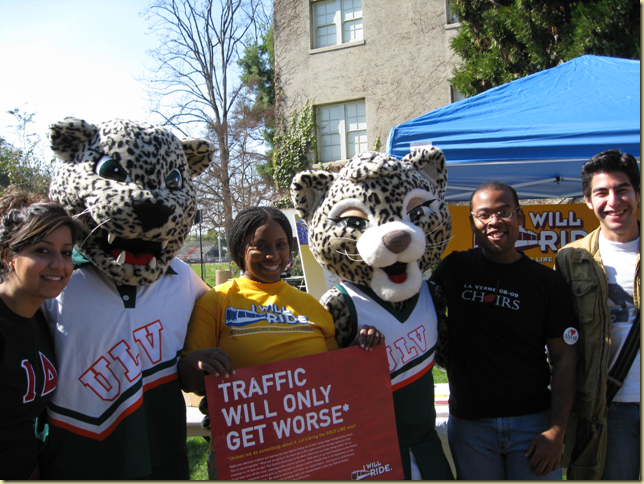
The rally, which will take place at Citrus College's campus center mall at 11 a.m., is part of the I Will Ride campaign.

The group is calling on Metro, Los Angeles County's transit agency, to begin funding the line in 2010 with funds from Measure R.

Measure R, a half-cent sales tax increase, was approved by Los Angeles County voters in November 2008 and is expected to generate $40 billion dollars over the next 30 years to fund transportation projects and provide traffic relief.

Metro is expected to make the decision regarding funding priorities and project timelines during its May or June board meeting.

"The Metro board, at its meeting Feb. 26, approved a plan to seek federal stimulus package funding that included $150 million for the Gold Line Foothill Extension." CEO of the Metro Gold Line Foothill Extension Construction Authority, Habib Balian wrote in a February posting on the I Will Ride website. "The good news is that the Metro board in a unanimous vote officially supported the project and directed Metro staff to make sure that the Gold Line Foothill Extension is ready to seek federal funding when the money becomes available."

The extension would bring the Gold Line from Pasadena to Azusa and then in later phases to Montclair/Claremont and eventually to Ontario Airport.

"It is undoubtedly important that we support this process," Associated Students of Citrus College Vice President Abigail Thompson said. "As we progress toward going green, people are thinking about how they can cut costs. Also, with the Gold Line we will be able to effectively draw more students to campus since the station will be across the street."

The extension will be beneficial to students throughout the San Gabriel Valley because once fully completed more than 28,00 students and 3,500 faculty/staff across 12 campuses will be within a half-mile radius of stations.

"Students and faculty members recognize that connectivity among these institutions of higher learning can create an unmatched academic atmosphere for the region that encourages an exchange of ideas and having a broader exposure to the other campuses. It is precisely because of the academic community that the I Will Ride campaign was created," Balian said.

Students have been a driving force behind moving this project along.

"Students created this campaign because they see the value of the project, and are also willing to fight for their fair share of Measure R dollars so that they can begin to see the benefits as soon as 2013 with the completion of first phase of the extension to Azusa." Balian said. "The next step is getting the train as far as Claremont, where it will connect with the Claremont Colleges."

In addition to helping local academic institutions, the extension will also benefit local economies, generating more than 30,000 construction-related jobs and thousands of jobs in transit-oriented developments, according to Balian.

For more information on the rally or the Gold Line Foothill Extension, visit www.iwillride.org.

Emily Rios can be reached at Rios_EmilyC@yahoo.com


39 comments so far on high-speed rail/Megalev discussion

Plans for high-speed Vegas to Victorville train line unveiled - Las Vegas Sun

 
Discussion: 39 comments so far on high-speed rail/Megalev discussion

1.

By Russell Morgan
4/28/09 at 2:27 p.m.
Suggest removal

Am I the only one that thinks that no one from Las Vegas will ride this to Victorville? For a family of 4 you are talking a $400 round trip (based on their $50 one way price point) and you still would have to rent a car in Victorville and still have to drive through LA traffic or down to San Diego to get to your final destination.

At least if you could take a Maglev to Anaheim you could do a Disneyland weekend without having to rent a car.
2.

By Brian_Eckhouse (Staff)
4/28/09 at 2:32 p.m.
Suggest removal

Couple clarifications on Mr. Morgan's comment: 1) The maglev group pitched the $50 price point. (We could know more tonight about how much DesertXpress will charge). 2) Maglev's route would terminate about two miles from Disneyland, not at the theme park as some critics have said.
3.

By Mandy
4/28/09 at 2:46 p.m.
Suggest removal

Does money really have to be spent on something like this? It's not as if the ride between the CA cities and Las Vegas is so horrendous that you couldn't enjoy the 3-4 hr ride. And driving it would cost much less than $50 per person. Even if the final fare would be less than $50, ie $30-35, it still would be cheaper. Waste of money to build this thing.
4.

By revtomperl
4/28/09 at 2:50 p.m.
Suggest removal

I would think that there are interesting alternatives such as restoring AMTRAK service to Las Vegas and / or creating a north south route which would connect from Salt Lake City and Las Vegas and Kingman and maybe someplace in Arizona on the Sunset Limited. That would give access to a variety of transcontinental routes. It would work for those who do not choose to drive gas guzzlers or those who do not have transportation alternatives and for some of us who hate airplanes. Ok, have a GREAT day! ALL ABOARD!
5.

By poker_ray
4/28/09 at 3:10 p.m.
Suggest removal

Maybe it can make a stop at the new City Hall. They can call it the "ScamTrak".
6.

By in_sider
4/28/09 at 3:19 p.m.
Suggest removal

Russell: You're thinking of it incorrectly, this isn't a way to transport Las Vegans to SoCal it is a way to get SoCals to LV. That's the traffic/transportation problem we have.

Mandy: In not the so distant future driving a car any distance or flying in a jet will be so unbearably expensive that rail service will be one of the only long distance mass transit alternatives available to the middle-class. Oil is finite, that means we need alternative transportation services to places like Las Vegas in which their entire economy is based on getting people there cheaply.

RevTomPerl: You make a lot of sense, but we need to think beyond the old model of AmTrak. A wide spread high-speed rail system is one of the few answers to
7.

By Russell Morgan
4/28/09 at 3:52 p.m.
Suggest removal

In_sider: It seems shortsighted to me to spend billions of dollars on a train line that only serves people on one side of it. Yes, the main issue at hand is getting people from CA to LV, but not every user of I-15 hails from California. That seems about as wise to me as building a monorail that basically only serves tourists, and then wondering why the locals don't ride it. I guarantee they would still try to market it to Las Vegans to get to SoCal, and we'd be seeing countless news items on "why won't Las Vegans take the Desert Xpress?"

Brian: Thank you for the clarification. I was not aware of where the Maglev terminus would be located. I might add though, even if the Maglev terminated 2 miles away from Disneyland (or Angels Stadium, or the Honda Center) and I had to take a $10 cab ride (or possible a free hotel shuttle), that would still be preferable than trying to rent a car in Victorville.
8.

By Nick
4/28/09 at 3:52 p.m.
Suggest removal

Great. I would love to use the train. Also expect buses and other transport to pick up at Victorville. It's a step in the right direction.

If gas goes back to $4.50 a gallon, Las Vegas will be cooked.
9.

By JayeTT
4/28/09 at 4:07 p.m.
Suggest removal

A high speed ride to Victorville? What's next? High speed rail to Ely?

I'm with Russell--I'd rather terminate anywhere in Anaheim over Victorville any day.

This project is so dead.
10.

By nednougat
4/28/09 at 4:08 p.m.
Suggest removal

Something nutty here. You've got Amtrak-yes, it's a piece of crap, but take a piece of all the billions, and simply reroute Amtrak through Vegas like it was in the mid-90's. Upgrade the rails and such with all that money. Right now, Amtrak has been starved to death-have you ever been to Kingman? A waiting room the size of your kitchen, and the train pulls in at 4:00 AM! But guess what? Its final stop is Union Station-like in downtown LA. Not that Barstow clone idea-hey, let's spend a weekend in Victorville, and visit the Roy Rogers Museum. What, it's long gone? This is easily the nuttiest idea since Oscar's Town Hall.
11.

By payrolldept
4/28/09 at 4:11 p.m.
Suggest removal

I'm not so sure I'm buying in to the passenger use numbers the website is quoting.
I'm in San Diego twice a month. I want to say this is a great idea; but I wouldn't use this train...
Who wants to be in LA with no wheels? And a rental car isn't cost effective.
12.

By Nick
4/28/09 at 4:18 p.m.
Suggest removal

Once the train is in LA area it will get expanded. Progress has been wonderful in L.A.

This could be huge for Las Vegas.

and I agree getting people TO LV is the goal.
13.

By Lenny_V
4/28/09 at 4:46 p.m.
Suggest removal

If the plan was to have another station in OC, and one in the northern SF valley or Santa Clarita, then I say yes, good idea. But if the final destination/starting point is Victorville, forget it. No one is driving 90 mins to Victorville then getting out of their cars to hop on a train.
14.

By jaesun
4/28/09 at 4:54 p.m.
Suggest removal

what a waste of money. thank you obama for pushing this? extend it to LA for goodness sake!
15.

By Our_Linn
4/28/09 at 5:13 p.m.
Suggest removal

Victorville?!?!?!?!?

hahahahahahahahahahahahahahahaha
16.

By Dave V
4/28/09 at 5:57 p.m.
Suggest removal

This isn't the only non mag-lev train plan in the works. It's just the first to get publicity. There is another one planned that will go all the way into L.A. and will probably be in operation sooner than this one.
17.

By LemonSky
4/28/09 at 6:01 p.m.
Suggest removal

I'm just throwing ideas or thoughts out there, but nevertheless...

We're about to have thousands of construction workers as well as those involved in the supply chain out of work once Fontainebleu and City Center are complete. This will further devastate the already abysmal LV economy, leading to a strain on public resources and further deflating the demand for private enterprise goods and services. This can have a domino effect that can lead to population exodus and erosion of property values, for example. Having something like this rail fast-tracked could soften the blow.

But OMG, it reeks of social welfare!

Actually, hundreds of private businesses will benefit from a project of this magnitude. I'm sure the proposal can effectively calculate a generous multiplier effect for the High Desert through to Las Vegas.

There is a risk to this becoming a colossal boondoggle, but what's the old saying? Nothing ventured, nothing gained?

Unfortunately, the debate surrounding funding will inevitably be fueled with vitriol. A desperate Republican Party would use this as an example of government spending run amok. Never mind the fact the Southern states which are overwhelmingly rep'ed by Republicans suckle at the public teat more than any other region in the US. In fact, California and Nevada pay more in taxes than they receive from DC, so really, funding is just a means of getting to what these states are justifiably entitled.
18.

By 2zero
4/28/09 at 6:52 p.m.
Suggest removal

We can not even get the monorail to the airport! Fly to Vegas, rent a car...or pay a taxi!

Fly to Portland or San Fran, soon SLC, and there is mass transit to the business areas. Then there are good alternatives to getting around town.

Lost on most, is the notion this and all the train/maglev projects are to enable the proposed Ivanpah (sp?) airport to serve Southern California. And make Nevada's power brokers and politicians richer.
19.

By captainamerica
4/28/09 at 8:07 p.m.
Suggest removal

Victorville! More fun than Yermo
20.

By neiman1
4/28/09 at 8:53 p.m.
Suggest removal

Did you notice this could be build by PRIVATE FUNDS. Get the government out. Let private operators take the risk and operate it without government employees. This is the only one that makes sense.
21.

By LasVegas2009
4/28/09 at 10:05 p.m.
Suggest removal

Lots of merchandise could be imported in on that train. Fresh seafood and other supply that now get flown in. This could be good for business and a big plus for all of us in Vegas. This country would be served well with a reliable train service. With the cost of fuel ever increasing I could see a day when we train rather than fly.
22.

By OldSailor
4/28/09 at 11:14 p.m.
Suggest removal

Building a pipe dream (rails in this case) makes for a lot of fun. The crowd of 100 people attending the presentation should show that this is not a viable project. I would wager that no amount of market research has been done to see if the target ridership of Southern Californians would consider this transportation option.

OK, you live in Burbank or Pomona and you want to visit LV for a long weekend. You drive to Victorville and park your car in the hot sun for 3 or 4 days Of course, the train will only run a few times a day so you wait for the next run. You now have only to pay $100 round trip per person to arrive in LV where you need a cab to get to your hotel. On the eventual return to Victorville and your filthy car (hopefully it's still there) you are wondering why you didn't just drive the rest of the way to LV and avoid the hassle.

If the goal is to get train passenger service to LV, then perhaps DesertXpress Enterprises would be open to spending money to enhance the current rail system from LA to LV, lease some passenger cars from AMTRAK, and convince the casinos to subsidize the price of the tickets. Atlantic City casino operators have a similar plan in place since February 2009.

Of course if DesertXpress Enterprises goes belly-up there is always a government bailout. Right?
23.

By Sunlizard
4/29/09 at 8:48 a.m.
Suggest removal

So this is what our beloved jacka$, Senator Reid wants to spend our money on...a train from Victorville to Vegas? I guess he wants it to go to Anahiem. What a fool. We can stop this BS with enough comments. Don't let Reid use the nation's economy for his retarded pet projects and be sure to vote his sorry a$ out in 2010..
24.

By nednougat
4/29/09 at 9:22 a.m.
Suggest removal

There's a great video post on Mish's Global Analysis about how well Victorville is doing. They're tearing down nearly completed houses rather than maintain them.

http://globaleconomicanalysis.blogspot.c...

It's called "Extreme home makeover depression edition."

So you really want to park your car in a desert hell, and wait for a train? And hope your car is still there when you return? Really people, how did this article become the headliner? Slow news day, I guess....
25.

By rumrunner
4/29/09 at 10:26 a.m.
Suggest removal

We have the monorail that go s no where,why not a train that does the same? Whats next? flight service to NLV AIRPORT FROM MACARRON? SEN REID,YOUR ARE NOTHING SHORT OF A CLOWN!!!
26.

By dart330
4/29/09 at 11:43 a.m.
Suggest removal

This train will not be built with public funds. It is a traditional steel wheel on steel rail, not a maglev or an Amtrak train. None of the stimulus money goes to building this, it is all being done by a private company.

When it fails because Victorville is the terminus, hopefully Amtrak will be able to take it over and continue the service on to Los Angeles Union Station. This would probably require the states to buy the rails from the bankrupt company, essentially a government bailout for a bad business plan.

They are looking at restoring traditional Amtrak service as well using government funds, to read more about that check out:
http://www.rtcsouthernnevada.com/mpo/pla...
27.

By maxine
4/29/09 at 11:45 a.m.
Suggest removal

I for one would really like to see hi-speed rail between LV and LA. Get me to Victorville in an hour and I'm a happy camper. Hope they put in some connecting transportation to L.A. though. The other plans to go to Anaheim are just stupid. Since when did Orange County become the center of business for the LA region.

Having ridden the Maglev in Shanghai, I can only say it's fantastic. Fast and efficient. Takes 10 minutes to get into town vs 45 minutes by cab.

Another great alternative would be if we could have rail transport that would carry autos - like the ferry's do. It would save fuel big time.
28.

By jaesun
4/29/09 at 12:33 p.m.
Suggest removal

Anaheim vs Victorville....

ill take anaheim anyday

that's like telling cali people they building a rail to LV, but stopping at Baker or Stateline, just foot the rest of the way.
29.

By LemonSky
4/29/09 at 1:13 p.m.
Suggest removal

It's a bit disingenuous to think this can be constructed without one dollar of public money.

Ultimately, who is the Daddy Warbucks for this venture? They talk about long-term debt and equity financing, but from where? Phil Ruffin, with his impeccable business credentials and assets couldn't even procure a $100 million plus loan to finance a part of his purchase of Treasure Island. I'd like to see who'll be willing to invest in a highly risky enterprise that'll cost billions and inevitably go over budget and wait eons to recoup his investment based on $55 tickets x 10 million passengers per year less costs.

If they get any money, I'd guess it'll mostly come in the form of a public loan which may end up metamorphosing into a public grant. Or the budget may split into a public part which will go towards infrastructure upgrades and one for the actual rail construction which may come from that long-term debt and equity financing.

In all, there are all sorts of risks, but it has to be undertaken in one way or another.
30.

By STV
4/29/09 at 1:45 p.m.
Suggest removal

This looks like a GREAT deal, for California.

Follow the link to the desertexpress website. Most all of the jobs (and the only one maintenance facility) are located in California. the entire site is touting the great enhancement for Californians. The site evens talks about expanding to service other Californian areas for Californians. Are you getting the jist of this plan yet?

No mention of encreasing the amount of visitors to Las Vegas, only an option for those Californians who usually travel here by car.

So, we don't get many jobs, we lose tax revenues from less gas purchased by Californians.

Why is this such a great deal for Nevadans?
31.

By muddapucker
4/29/09 at 3:39 p.m.
Suggest removal

Put a tax on prostitution and pay for the damn thing.

Its about the only renewable resource that we'll have left.
32.

By hooloogoo
4/29/09 at 4:21 p.m.
Suggest removal

.
..
...A recent article in the New York Times sounded similar to the bloggers here. Spain built a train service to a distant bullfight region (Cordoba.???) and many Spaniards were pessimistic as they are homebodys in many regions over there.

...It turned out with successful results and many connecting branches now link up to the Madrid main lines connecting varied regions of that desert country.

...Bagging the expensive Mag-Lev trains is wise as it would be less expensive to upgrade existing rails and purchasing already proven bullet locomotives and cars. Make sure there is a robust club car for food and beverage as this was a hallmark for train travel in ye olde days.

...If train service proves successful in the trial period . New lines to San Diego, Apple Valley and the City of Angels (tee hee) could be added later. What to do when one reaches Victorville is beyond me but we are decades behind the European and Asian countries when it comes to serving their citizens in short term travel under five hundred miles.

...Finally Mayor Goodman could give free tickets to the homeless one way to sunny California....All Aboard.... Victorville....
33.

By davidwayneosedach
4/29/09 at 6:18 p.m.
Suggest removal

This is the future. China is already laying down tracks for these trains. We should be too. I agree the ultimate destination should be Anaheim, or even LA.
34.

By muddapucker
4/29/09 at 7:24 p.m.
Suggest removal

You need to spend the 3-4 billion dollars trying to find enough water to serve the area.

Is there a planning and zoning dept in LV or do you just build and build until you exhaust all your resources and reach total gridlock.

Its a concrete and glass canyon on Las Vegas Blvd. You can't even see the mountains anymore from the road. I guess you would have to be up 10-12 floors.

Heck, you can't even travel on the 215 and parts of the 15 during rush hour. Think maybe we ought to relieve the congestion within LV before we start piping people in here?
35.

By emperorjoe
4/29/09 at 11:41 p.m.
Suggest removal

Anyone remomber the claims of how successful the monorail would be? Don't believe the traveling carnies. This a a very bad idea.
36.

By SlumpDog
4/30/09 at 3:37 a.m.
Suggest removal

Monorail was poorly planned, nobody can find it.

Put the hub where UNLV is. Relocate UNLV to the mountains in a study friendly environment.

Developers will go hog wild developing land in between UNLV and the strip. Let California worry about where it branches from Victorville, we've got tunnels and redevelopment to worry about.

But a train on ground level doing 150 mph? What if a wild horse jumps in front of it?

I'm all for it, though. Solar powered... jets spew too much carbon, pain in the butt to get on the jet, no leg room, no social area. The train needs to offer more than just 'not an airplane'.

Get Coor's to sponsor it, done deal...
"People all over the world now, join hands...
Phhhwweewwwww, there goes the train....

I'd take the train if there were jobs in Victorville.
37.

By SlumpDog
4/30/09 at 3:49 a.m.
Suggest removal

Forget about the water. Clint Eastwood didn't need a pipeline of water. Just bathe a little less. Drink bottled water. WTF??? I don't know what it is with these people that want a grass lawn here.

That's right I stink and have sweat patches under my armpits... get used to it or leave!
38.

By henderson
4/30/09 at 12:23 p.m.
Suggest removal

This might make some sense if it at least went San Bernardino. This is extremely wasteful spending. By the time someone in Anaheim or LA drives to Victorville, parks their car, meets the stupid train, buys their ticket, this turns out to be a waste of both time and money. It's the reason why I drive instead of fly to Los Angeles. By the time I park at the airport, enter inside, check bags, go through security, fly for 55 minutes, land, find my luggage and a ride to hotel, I can drive my own car, spare myself the airport hassle, save money on plane ticket and rental car or shuttle service, and spend less time in the process. This is ridiculous!
39.

By rafael
5/3/09 at 9:22 a.m.
Suggest removal

DesertXPress ought to forget about Victorville and instead build a 215 mile spur off phase I of the California HSR system. It would run from a wye at Mojave to Vegas via Barstow, designed for a top speed of 220mph with a 25kV AC overhead catenary. Their illustrations should also be honest: overhead catenary systems require poles to hold up the wire. Note that if DesertXPress sticks with crossing the two mountains on the spur at grade, the alignment will include sections with 4.5% gradients. CHSRA is planning to build tunnels so it can buy and operate cheaper trains that are limited to gradients of 3.5%.

There would be no station at Mojave, instead DesertXPress would acquire trackage rights on the CA network to run *direct* trains between Anaheim-LA and Vegas via Palmdale airport. In addition, they could run direct trains between SF-San Jose and Vegas via Fresno.

Barstow-Mojave is a little longer than Barstow-Victorville but on the other hand, there would be no need to construct a huge parking lot. DesertXPress could leverage the California maintenance facility that will be built anyhow. Currently, there is talk of one at Castle Airport in Merced county, but there will also need to be one in Anaheim.


Bullet Train more viable than maglev for train to Vegas?

Plans for high-speed Vegas to Victorville train line unveiled - Las Vegas Sun
Plans for high-speed Vegas to Victorville train line unveiled

By Brian Eckhouse

Published Tue, Apr 28, 2009 (12:25 p.m.)

Updated Tue, Apr 28, 2009 (8:07 p.m.)

Sun Archives

* One-woman bureaucracy keeps maglev hopes alive (3-3-3009)
* Republicans don't let facts get in their way (2-26-2009)
* Did light-rail deriding Jindal get lost en route to '30 Rock'? (2-25-2009)
* Bill introduced to bring light rail system to Clark County (2-3-2009)
* Senator wants light rail system in Clark County (8-25-2008)
* Light rail option is derailed (3-4-3007)

A high-speed rail alternative to the oft-discussed magnetic levitation train to Southern California would be privately funded, create up to 3,000 jobs during construction and prompt the displacement of some desert tortoises, representatives of the Federal Railroad Administration and an environmental consultant told a crowd of about 100 people Tuesday evening.

The alternative, called DesertXpress, would connect Las Vegas to Victorville – not Anaheim, as the California-Nevada Super Speed Train Commission proposes for its fledgling maglev project. DesertXpress would operate at a speed of 150 mph – half that of maglev. A one-way ticket would cost about $55.

But DesertXpress Enterprises believes its project is more viable: a draft environmental impact statement was completed last month – so already it’s further along than maglev – and the cost, its representatives argue, would be far less with little to no long-term expense to taxpayers. DesertXpress could be funded through long-term debt and equity financing, as well as a public loan, a spokesman said.

Maglev representatives hope their environmental document is ready for public consideration in 12 to 18 months.

And, representatives of DesertXpress note, a second phase would connect the train – either diesel- or electric-based – to a nexus of public transit north of Los Angeles in Palmdale, Calif. The draft environmental impact statement did not include a study of the Victorville-to-Palmdale leg.

Construction on the first phase could be completed in four years.

Representatives of DesertXpress estimate that construction of the 180-mile project at $3.5 billion to $4 billion, whereas they predict the 260-mile maglev line at $16 billion to $52 billion. The commission, however, recently pegged the maglev project at about $12 billion.

DesertXpress would share existing transportation corridors, mostly Interstate 15. For example, an 85-mile stretch from Yermo, Calif. to Mountain Pass would be built in the freeway median and alongside it, said Scott Steinwert, president of CirclePoint in San Francisco. CirclePoint is DesertXpress’ environmental consultant.

A span of the train could be built along the Union Pacific Railroad into the Las Vegas area, north of Jean. And a section of I-15 in the southern Las Vegas Valley could be built over the median – Steinwert called this an “aerial structure” – akin to the elevated AirTrain over the Van Wyck Expressway in Queens, N.Y.

A potential Las Vegas station could be near I-15 and Flamingo Road, Steinwert said. A maintenance facility could be built near I-15 and Wigwam or I-15 and Robindale Road.

The environmental study identified potential problems. They include: some habitat damage for the desert tortoise and Mohave ground squirrel; the crossing of ephemeral streams; traffic near the proposed stations; and “significant” noise and vibration near Victorville, Barstow, Yermo and Las Vegas, though road improvements in all but Victorville could ease that disruption.

The pluses: the train could create up to 700 full-time jobs at proposed Victorville and Las Vegas maintenance facilities, lessen freeway congestion and improve air quality.

All 12 attendees who spoke during the Tuesday meeting at an off-Strip hotel supported high-speed rail, though some support maglev and one preferred a third option, a solar-based alternative.

The largest skepticism was for the Victorville terminus.

“A train starting in Victorville, how attractive will that be for people in Los Angeles? That’s our primary market,” said resident Tom Piechota.

Jeff Rhoads, president of the Argonaut Company in Las Vegas, implored DesertXpress leaders to ensure that whatever train technology is chosen that it aligns with the California system from Palmdale up to Northern California. Resident Glenn Trowbridge asked DesertXpress representatives to consider adding a station at the future Ivanpah Airport, south of the Las Vegas Valley. Resident Brett Gordon insisted a train needs to incorporate passengers and freight. (Southern California is home to some of the nation’s busiest ports).

Richann Bender, executive director of the California-Nevada Super Speed Train Commission, asked FRA representatives to consider her alternative “because only one train can exist on this corridor.”

The FRA approved DesertXpress’ draft environmental document last month. Comments from meeting attendees, as well as written testimony submitted by May 22, will be included in the final environmental document, said Wendy Messenger, the FRA’s project manager for the study.

For more information about the project, log on to desertxpress.com. Find more information about the environmental study here.


Tomorrow Rally for Gold Line Foothill Extension

Live Coverage of Tomorrow’s Rally « I Will Ride Blog
Live Coverage of Tomorrow’s Rally
Posted by Albert

Our rally tomorrow is going to be the beginning of a series of big events for the Gold Line Foothill Extension in the month of May (more on that in another post).

For those of you who can’t make it to our rally (because of class or work), we’ll be covering the rally live on our Twitter feed @iwillride.

If you happen to be in the area tomorrow, drop on by! Our rally will warm up around 10:30 AM and get started at 11:00 AM.

Just look for a sea of yellow (gold!) shirts on the Citrus College campus with words of wisdom pasted on the back – like “Azusa in 2013” or “The San Gabriel Valley Counts Too!” or (the wisest one of them all) “Fund the Gold Line Now!”.

Food and refreshments will be served afterwards for lunch.

Rally information posted below:

Gold Line Foothill Extension Rally at Citrus College
Thursday, May 7, 2009
Meet and Greet: 10:30 a.m.
Rally: begins promptly at 11 a.m.
Campus Center Mall
1000 West Foothill Boulevard
Glendora, CA 91741


Bullet train construction could mean 150,000 jobs.

Central Valley Business Times
Bullet train czar says construction could mean 150,000 jobs


SACRAMENTO
Comment Print Email Digg Newsvine
May 6, 2009 1:45pm

• Quentin Kopp says 800-mile system will be built in stages

• Trains will travel at 220 miles per hour in Valley

State Agriculture Secretary A.G. Kawamura was another keynote speaker. He told the meeting that farmers and ranchers need to shake stereotypes. "We're not the Midwest," he said, adding that too many people not in the food industry cling to old myths about it.

Construction of the California bullet train system could generate as many as 150,000 jobs, says Quentin Kopp, chairman of the California High-Speed Rail Authority in remarks to the annual meeting of the Great Valley Center today in Sacramento.

“Its construction phase, over the period between now and the year 2025 when the entire 800 miles will be operating for revenue service, will create about 150,000 construction-related jobs,” says Mr. Kopp, who was one of the keynote speakers of the two-day meeting of the think tank and its supporters.

But that would be the tip of a major boom in jobs, if his predictions pan out. Mr. Kopp says once the full project is operating it will mean “450,000 plus or minus permanent new jobs.”

He says the system is likely to build its maintenance facility in Merced. It also plans to build one of the first segments of track between Merced and Bakersfield and use it as a test track.

“High speed rail is not a new technology,” he says, pointing to Japan’s bullet trains which began operating 44 years ago. He says 11 countries have high-speed train service.

“And now in China. China anticipates and brags that it will have in two years 3,000 miles of high-speed rail,” Mr. Kopp says.

California’s would be the first in the United States.

Mr. Kopp says the speedy trains could remake much of the Central Valley, which has been isolated by distance from the state’s major commercial centers of San Francisco and Los Angeles.

“You’ll be able to travel from Fresno to San Jose, for example, in 65 minutes,” he says. “Obviously it will enable commuting between the Central Valley and the Bay Area, the Silicon Valley and Southern California … in a way that’s comfortable and also practical,” he says.

The bullet trains, he says, will offset the Valley’s paucity of economical air travel and avoid having to build more freeways.

“In so many ways, the Central Valley is the most important part of this project,” Mr. Kopp says.


Obama seeks high-speed rail system

Obama seeks high-speed rail system — TheTransitWire.com
Obama seeks high-speed rail system


April 16, 2009

President Barack Obama outlined his vision for a network of high-speed rail lines across the United States today. The federal government has identified 10 potential corridors for rail development:

* Northern New England
* New York State
* Pennsylvania
* Chicago area
* District of Columbia to Florida to the Gulf Coast
* Gulf Coast line from Texas to Alabama
* Central and southern Florida
* Texas to Oklahoma
* San Francisco to Los Angeles
* Pacific Northwest

“Imagine whisking through towns at speeds over 100 miles an hour, walking only a few steps to public transportation, and ending up just blocks from your destination,” Obama said. “It is happening right now; it’s been happening for decades. The problem is, it’s been happening elsewhere, not here.” Link to full story in The New York Times.


TransitWire, another excellent source of information on mass transit

About Us — TheTransitWire.com


Information on emerging transit technology
About Us

The Transit Wire provides information on state-of-the-art technologies used in the public transportation industry. Our goal is to present current, useful and objective information to transit properties, government agencies, researchers, consultants, and vendors.

This project is funded by the Transit Cooperative Research Program.
Project Team

Robert Brodesky (URS Corporation), Publisher
Jordan Karp (URS Corporation), Assistant Publisher
Susan Bregman (Oak Square Resources), Editor-in-Chief
Shubha Shrivastava (URS Corporation), Associate Editor
Contact Us

We invite you to email us with questions, comments, photos to share or if you would like to be a guest contributor.

Email: editor@thetransitwire.com


Orange Line Extension starts construction in June and will open in 2013

Curbed LA: Orange Line Extension Coming, Businesses Going
Orange Line Extension Coming, Businesses Going
Tuesday, May 5, 2009, by Neal Broverman


Ground will be broken next month on the four-mile extension of the Orange Line busway in the West Valley, with an expected ribbon-cutting in 2013. Bringing the line from Warner Center to the Chatsworth Metrolink Station on a Metro-owned corridor will require about 60 businesses that lease space to the transit agency to relocate, reports The Daily News. Metro says they're paying moving expenses for businesses with long-term leases, as well as paying the difference in the businesses' new rental rates. But Bob Jacobi, co-owner of Jacobi Building Materials, a business that will lose a chunk of space from its lot, asks, "When there are so many places going out of business either on their own or through the economy, why should the government get involved in removing more businesses?" Jack Kyser of the LA County Development Corp. counters with, "No matter where they put the extension, there would be complaints about where they put it." And on the DN comment board: questions why this packed busway isn't being converted into light-rail. [Daily News]


Foothill Transit to introduce electric bus with Stimulus money

Foothill Transit to introduce electric bus — TheTransitWire.com
Foothill Transit to introduce electric bus

May 6, 2009

Foothill Transit, in West Covina (CA), will use federal stimulus funds to purchase three electric buses and wayside fast-charging equipment from Proterra LLC. The buses can travel 30 miles between charges; the docking stations can deliver a 95% charge in less than 10 minutes. “Recent rapid advancement in battery and vehicle technology have made this bleeding edge project possible,” said Peggy Delach, Chair of Foothill Transit’s Executive Board. “And the challenges that we face with our environment demand that we expand beyond what’s available into what’s possible. This is the time and place for possibility. Excited doesn’t begin to describe how we feel. This is history.” Link to press release from Foothill Transit.


Urban Planning, transportation planning, environmental planning and other sorts of planning should be integrated, argues the author of this article.

Seizing A Historic Moment In Urban Planning - Forbes.com
The State Of The City
Seizing A Historic Moment In Urban Planning
Scott Sarver, 05.05.09, 06:00 PM EDT
Will our new city schemes compare to Daniel Burnham's?


On the 100th anniversary of Daniel Burnham's landmark "Plan of Chicago," America has arrived at a historic watershed moment. We are at a unique point in time where there is an alignment of need with funds in the form of the administration's infrastructure package. Together they could fundamentally change the shape of our urban centers. Our challenge: to look beyond the present and envision what our cities can be--not what we're resigned to accept.

Burnham was able to envision a dynamic and diverse patchwork of neighborhoods, all connected to a defining lakefront through a string of large and vibrant public parks. His plans shaped not only the built environment, but also the culture of cities like Chicago and San Francisco, and how people interact within them. It is this visionary aspect of his foresight that we must keep at the front of our minds as we begin to seize our historic opportunity. All too often the distant vision succumbs to the short view--a pitfall that tough economic times bring about.
Article Controls
Urban Planning, transportation planning, environmental planning and other sorts of planning should be integrated, argues the author of this article.

While there are many vast new urban redevelopment plans on the drawing board across America--and many of them will be vying for federal infrastructure funding--I propose that they be weighed not just against economic viability, but also cultural merit and compatibility with our values. We must ask ourselves:

--Do these plans support a sustainable, productive and connected future for our urban centers and their satellite communities?

--How do we ensure our changes stand the test of time?

--How do we maintain vitality through the regeneration of our existing building stock?

We are at the forefront of a movement with the potential to shape our cities into sustainable, interconnected urban centers. To get there, we can (and should):

Shift our resources from the sprawl-induced, isolating car culture to a mass transit-based system. This paradigm shift will benefit the individual because it is cheaper and provides a higher-quality experience, and it will benefit the broader community by supporting density and using resources more efficiently. This step must begin with a razor-sharp focus on infrastructure
.


Environmental Defense Fund Advocacy Report for mass transit

Reinventing Transit:
American communities finding smarter,
cleaner, faster transportation solutions


"This report showcases the new generation of innovative public transit already operating in a variety of communities across America. Our goal is to shatter the preconceived notion that transit is exclusive to more traditional urban centers and that it is slow and unreliable. Through 11 case studies, we demonstrate how cutting edge transit has been implemented quickly and cost-effectively in a variety of settings from urban to rural.
Expanding cost-effective transit options is key to our nation’s economic and
environmental health. On the environmental side, transportation sources are
responsible for about a third of U.S. global warming pollution—most of which comes from cars and trucks. Economically, investments that expand transit provide more and longer-lasting jobs than investments to expand highways, while boosting economic development, enhancing real estate values and helping relieve consumer
reliance on foreign oil.1"

Click below for link to PDF:
http://www.edf.org/documents/9522_Reinventing_Transit_FINAL.pdf


Public-Private Partnerships for Highway Infrastructure: Capitalizing on International Experience

The U.S. Federal Highway Administration has released a report that explores public-private partnership programs for highway infrastructure in Australia, Portugal, Spain, and the United Kingdom.

Link to report below:
http://international.fhwa.dot.gov/pubs/pl09010/pl09010.pdf