Pedestrian View Of Los Angeles

This blog focuses on rail lines in LA country that exist, are under construction or under consideration. The Californian high-speed rail project and southern CA to Vegas project will also be covered. Since most of the relevant developments in the news, rail websites and blogosphere take place on weekdays, this blog will be updated primarily Monday through Friday and occasionally on the weekends. Your comments, criticism and suggestions are encouraged. Miscellaneous stuff will also appear here.

More content as you stroll down on the right side

1. Blog Archive
2.
Blog List and Press Releases
3.
My Blog List
4.
Rail Lines: Existing, Under Construction and Under Consideration
5.
Share It
6.
Search This Blog
7.
Followers
8.
About Me
9.
Feedjit Live Traffic Feed

Tuesday, July 7, 2009

From energy, environmental, safety standpoint, rapid rail could yield biggest bang for buck (Source: Fresno Examiner)

Link: From energy, environmental, safety standpoint, rapid rail could yield biggest bang for buck

From energy, environmental, safety standpoint, rapid rail could yield biggest bang for buck


I’m not a gambler. This could explain why I’m neither rich nor poor. But there is one bet I wouldn’t hesitate to place and that would be on high- speed rail.

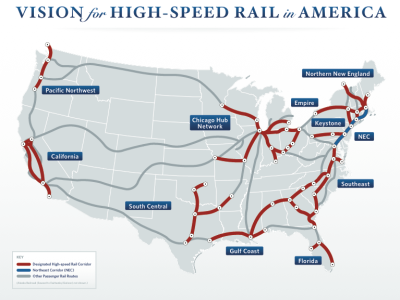
But, all bets may be off if we don’t get rapid rail in this country and get it soon. There is $8 billion of stimulus money available, primarily, it seems, for two high-speed rail projects: the Midwest regional HSR initiative which has Chicago as the hub with lines radiating out in several directions and the North-South California High-Speed Train network linking San Francisco and Sacramento with Los Angeles, Anaheim and San Diego. Other potential high-speed rail routes have been identified as well.

What makes this type of transportation a sure thing is its track record. It simply can’t be beat for safety, environmental sustainability and energy efficiency!

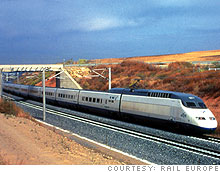
Electrically powered high-speed trains, besides being quick, are quiet, comfortable, reliable and safe. Speaking of safety records, HSR is one of the safest – period. Credited with forty-five years of active operations, accidents involving high-speed trains have been rare. One in Germany in 1998 was attributed to mechanical failure when a wheel fractured and disintegrated.

From Wikipedia via the List of Rail Disasters there are these four. There may be others.

A crash in Spain in 2002 occurred when trains collided. Another was due to an earthquake (Japan, 2004). A third resulted from a bridge washout caused by heavy rains (Italy, 2005). And one, on a maglev line, involved the train striking a railway maintenance truck (Germany, 2006).

Operational parameters

High-speed trains operate on their own dedicated tracks with no interference from vehicle traffic. There are no intersections with roadways – all vehicle/pedestrian traffic is carried over or directed under high-speed rail lines much like what exists with interstate highways. Express trains run around or bypass non-express trains at intermediate stations and perhaps other places via run-around or bypass tracks and trains are computer-controlled to maintain reliability and efficiency. Running in territories where distances are between 50 and 1,000 miles, HSR is ideal. And, yes, trains traverse the countryside between metropolitan stops on many corridors in many locales, which may be difficult for some people not familiar with HSR to visualize. Such would be the case with the California high-speed rail system once built and operational.

'No better investment'

When it comes to transportation endeavors, I see no better investment than in rail, high-speed rail in particular.

That being said, I have trouble understanding why it has taken us so long to figure out what the Asians and Europeans have understood and valued and found value in, for so long. Rapid rail will find a home in the U.S. It’s now a question of where and when. High-speed rail is absolutely something we should be able to bank on someday.


Author: Alan Kandel


New rail corridor between L.A. and Las Vegas could doom maglev project (Source: Los Angeles Times)

Link: New rail corridor between L.A. and Las Vegas could doom maglev project - Los Angeles Times
New rail corridor between L.A. and Las Vegas could doom maglev project. Corridor along I-15 draws support from Senate Majority Leader Harry Reid, who says he will try to move funds from the maglev project to a new, European-style train system.

By Ashley Powers and Dan Weikel
July 3, 2009

Reporting from Los Angeles and Las Vegas -- A potential corridor for passenger trains between Las Vegas and the Los Angeles area has become part of a federal initiative to modernize the nation's rail networks and develop high-speed service between cities.

Thursday's announcement, however, might doom a 30-year-old proposal to build a high-tech magnetic levitation, or "maglev," train from Anaheim to Las Vegas if Senate Majority Leader Harry Reid (D-Nev.) gets his way.

Reid, who no longer supports the maglev project, said during an event to publicize the rail corridor that he would try to scuttle $45 million in federal funds earmarked for the proposal. The maglev project and a conventional rail line proposed by a private venture are trying to develop separate high speed passenger trains that would parallel oft-congested Interstate 15. Secretary of Transportation Ray LaHood announced Thursday that a swath of land along much of I-15 has been declared a federal high-speed rail corridor -- one of 11 such zones in the U.S. Projects proposed in those corridors are eligible for federal assistance, grants and loans.

Federal officials say the development of a successful high speed rail system between Southern California and Nevada would dramatically reduce delays and traffic accidents on I-15.

"For transportation, it's the most important thing that's happened to Nevada since Interstate 15," said Reid, who likened the federal high speed rail program to President Eisenhower's effort in the 1950s to develop the interstate highway system.

Last month, the Nevada senator withdrew his support for the maglev project in favor of a plan by DesertXPress Enterprises to build a European-style high speed train that relies on conventional technology. The 150 mph system would run about 200 miles from Victorville to Las Vegas and cost about $3.5-$4 billion to build.

The maglev project would extend 270 miles and cost an estimated $12 billion. Maglev technology relies on electricity and magnetic force to propel trains on a cushion of air at speeds up to 300 mph.

"I've studied maglev enough," said Reid, who added that the DesertXPress is closer to breaking ground. "We're past the planning stage. We've got to move on and start construction."

Proponents of the maglev proposal said it was unlikely that Reid would be able to persuade Congress to reverse its decision to provide funding.

"We are relying on the law and how it reads. We believe that nothing will change," said Neil Cummings, president of the American Magline Group, a consortium of private companies involved in the project.

ashley.powers@latimes.com

dan.weikel@latimes.com


Expo Line Transit Service Interface Proposal — Part 1: Culver CityBus (Sourcce: MetroRiderLA)

Link: Expo Line Transit Service Interface Proposal — Part 1: Culver CityBus | MetroRiderLA
Expo Line Transit Service Interface Proposal — Part 1: Culver CityBus
Contributed by Wad on July 6th, 2009 at 1:00 am


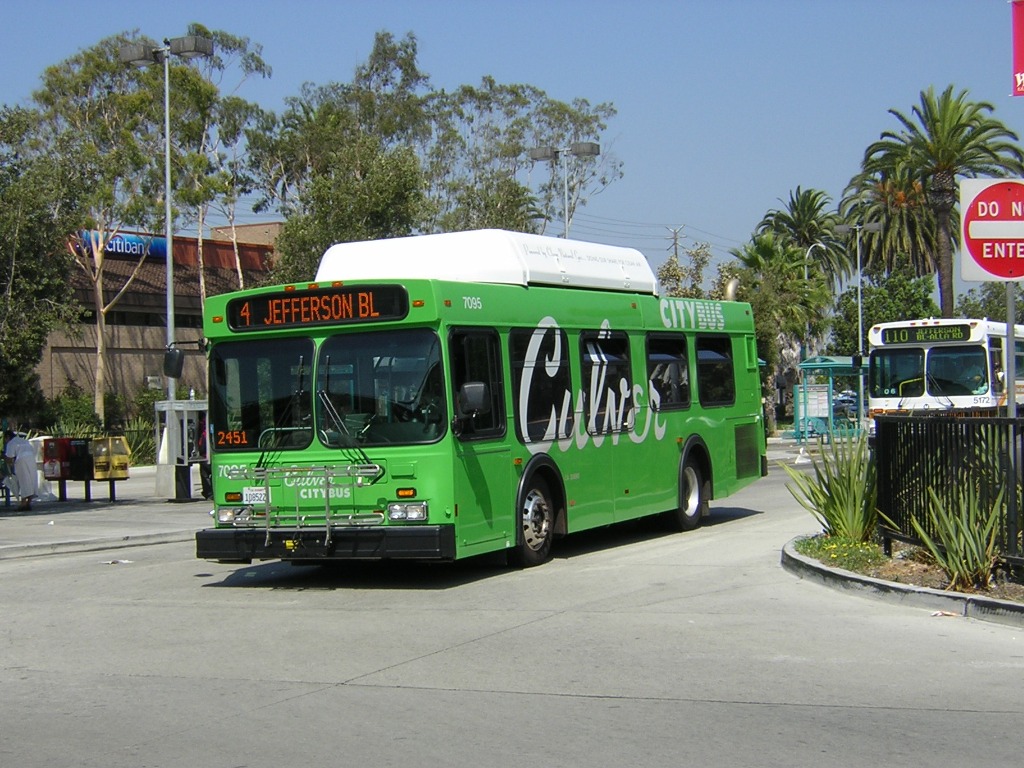
Photo by Scott Page, uploaded by Metro Library and Archive on Flickr; used with a Creative Commons License

Welcome back to the latest installment in the Open Source Transit series. Our previous series focused on bus service changes that allow for better connections to the Eastside Gold Line. The purpose of Open Source Transit is twofold: It lets riders start the discussion in how services should be shaped around our travel patterns. It is also a learning experience for riders, as we learn how and why transit agencies support or reject service changes.

The new installment is much narrower in scope yet still critical in importance. This three-part series focuses on improved bus connections to Phase 1 of the Expo Line. The three proposals in this series involve Big Blue Bus, Metro and the agency presented here, Culver CityBus.

This is the present PDF system map of Culver CityBus. The changes that are suggested for all the routes in the Transit Service Interface Proposal can be viewed in this Google Map. If you have any comments on the routing changes presented here, leave them in the comments or send them via e-mail. Please leave your name. Comments will be given to Culver CityBus to support or rebut the plans made here.

In a nutshell, Culver CityBus has the potential to become a much bigger player in Los Angeles transit. It will be thrust in this role anyway, as it will see an influx of ridership when the Expo Line opens and has been operational for a while. The more modest changes involve relocating the services from the “West Los Angeles Transit Center,” that depressing bus stop and layover area beneath Interstate 10, to Culver Junction. The more ambitious changes involve green buses taking over the orange buses operated by Metro. A couple of the changes will not connect with the Expo Line, but are added here because it would make sense to restructure services at the same time.

As a reminder, these proposals are not official by any agency and are not endorsed by them. The table of changes and rationales follows the jump.

Line 1
Rationale: Proposal calls for Culver CityBus to provide a crosstown bus service along Washington Boulevard between Venice and Union Station. Metro Line 35 would become attached to Culver CityBus Line 1. Line 1 would also restore service along Alameda St. between the Little Tokyo Gold Line station and Washington Blue Line Station.

Route: Union Station, Vignes St., Alameda St., Washington Bl., Culver Junction Expo Line Station, Washington Bl., Pacific Av., Windward Av. and Main St.

Line 2
Rationale: Existing Line 2 is a low-performing community route. The buses allocated to this route would run between Westfield Shoppingtown Fox Hills and Fisherman’s Village. Culver City can provide this service at a lower cost. Despite this proposal included with the Expo Line Transit Service Interface Proposal, it would not connect with light rail.

Route: Westfield Shoppingtown Fox Hills, Sepulveda Bl., Centinela Av., Mesmer Av., Jefferson Bl., Inglewood Bl., Washington Bl., Centinela Av., Short Av., Mindanao Wy., Admiralty Wy., Fiji Wy. and Fisherman’s Village.

Line 3
Rationale: This fairly busy Culver CityBus route would now have a deviation to Culver Junction to connect with the Expo Line mid-route. Also, the route adjacent to Westfield Shoppingtown Fox Hills would be eliminated and now provided solely by Metro Line 110.

Route: Century Park W., Constellation Bl., Century Park E., Olympic Bl., Beverly Glen Bl., Pico Bl., Westwood Bl., National Pl., National Bl., Motor Av., Washington Bl., Culver Bl., Venice Bl., National Bl., Culver Junction Expo Line Station, Culver Bl., Overland Av., Freshman Dr., A St., B St., F St., Freshman Dr., Overland Av., Playa St., Sepulveda Bl. and Westfield Shoppingtown Fox Hills.

Line 4
Rationale: The proposal calls for a single bus to operate on Jefferson Bl. The existing Line 4, west of Culver Junction Expo Line station, would provide a single Jefferson Bl. bus between the rail station and Playa del Rey. It would replace Metro Line 110 west of Fox Hills Mall.

The more ambitious route calls for Culver CityBus Line 4 to assume the routing of Metro Line 38 between the Culver Junction and Jefferson Expo Line stations. Line 38 would then be relegated to East Jefferson Bl. (See the Eastside Gold Line Transit Service Interface Proposal).

Route: (West of Culver Junction) Culver Bl., Vista del Mar Av., Culver Pl., Culver Bl., Jefferson Bl., Slauson Av., Sepulveda Bl., Westfield Shoppingtown Fox Hills, Sepulveda Bl., Jefferson Bl., Overland Av., Freshman Dr., A St., B St., F St., Freshman Dr., Overland Av., Jefferson Bl. Higuera St., Washington Bl. and Culver Junction Expo Line Station.
(East of Culver Junction) Culver Junction Expo Line Station, National Bl., Jefferson Bl., Figueroa St., 33rd St., Figueroa St. Jefferson Expo Line Station and Jefferson Bl.

Line 7
Rationale: Culver CityBus can provide the Marina del Rey portion of Line 108 more effectively, and attract more riders to Marina del Rey by connecting with the Expo Line. Therefore, Line 7 would become an all-day version of LADOT Commuter Express Line 437, providing two-way service in Marina del Rey.

Route: Culver Junction Expo Line Station, Culver Bl., Alla Rd., Bonaparte Av., Glencoe Av., Lincoln Bl., Mindanao Wy., Admiralty Wy., Via Marina, Pacific Av., Windward Av. and Main St.

Line 8
Rationale: Culver CityBus would assume the Baldwin Hills portion of Metro Line 439 between Culver Junction Expo Line station and Westfield Shoppingtown Fox Hills. Metro Line 439 would be converted to Line 539X, a blue-bus express service (see Metro service plans).

Route: Culver Junction Expo Line Station, National Bl., Fairfax/La Cienega Expo Line Station, La Cienega Bl., Centinela Av., Bristol Pkwy., Green Valley Cir., Sepulveda Bl., and Westfield Shoppingtown Fox Hills.


Gold Line emulator can’t cut it, so Metro will (Source: metroriderla.com)

Link: Gold Line emulator can’t cut it, so Metro will | MetroRiderLA
Gold Line emulator can’t cut it, so Metro will
Contributed by Wad on July 3rd, 2009 at 3:00 am

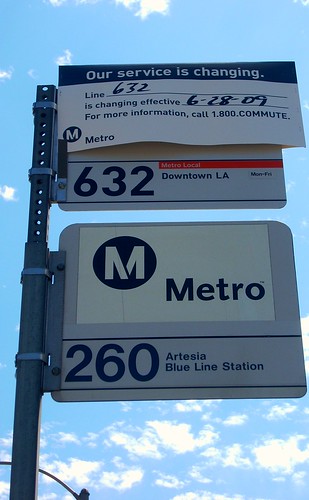
Bus stop sign of Lines 632 and 260

That sign at the top may become a hot seller on eBay come Monday.
Photo by Yours Truly via Flickr. See more photos like it, or contribute yours to the MetroRiderLA Flickr pool

Just as quickly as Metro Line 632 came into existence, much of it is already going away … and it has only been in service for a week.

Metro is cutting back 632 to within Los Angeles city limits effective Monday. The line will only travel from Union Station to Indiana Station. Passengers wishing to go between Indiana and Atlantic/Pomona stations must transfer to Montebello Bus Line 40.


Google Transit Arrives in L.A. just in Time for Tomorrow’s Memorial (Source: LA streetblog)

Link: Streetsblog Los Angeles » Just in Time for Tomorrow’s Memorial, Google Transit Arrives in L.A.

Just in Time for Tomorrow’s Memorial, Google Transit Arrives in L.A.


by Damien Newton on July 6, 2009

How to avoid traffic and get to the Staples Center tomorrow. Image: Friends for Expo

In case you've been living under a rock for the past week, you know that Michael Jackson has passed away and a memorial has been planned for the Staples Center tomorrow. The city is bending over backwards to try and figure out what to do with all of the cars that will descend on the Downtown for the memorial, to the point that I even watched Council Woman Jan Perry give a five minute interview on the expected traffic crunch and how mourners can avoid the jam without once mentioning the words, "transit," or "bus," or "Blue Line," or "bicycle."

While taking transit to the event may not have occured to the City Council as a way to beat traffic, google and Metro are informally working together to make certain that information is just a couple of clicks away.

After years of its public demanding that Metro share data with google as agencies around the country have already done; Google Transit for Metro has finally launched. LAist has already covered the launch. While the routing is still a little buggy, Metro is already claiming this is a test and not to get too worked up over any mistakes. Amusingly, Metro staff says that they aren't at the point of making an announcement, despite the service's available since for the last three days and the news articles heralding its announcement.

Meanwhile, if you want to tryout letting google map your transit route, using the application is as quick as typing "maps.google.com" into your browser and selecting the transit option from the drop down bar on the left. I've already gotten some feedback on weird routing. For example, my sister-in-law decided to use google transit to map a trip from her house in Woodland Hills to the Staples Center. Despite living a couple of blocks from the Orange Line, google transit would have sent her on five different local bus routes on a three hour oddyssey. Feel free to leave your feedback for Google and Metro or the results of your own experimentation in our comments section and I'll make certain they are passed along.


Metrolink to Add More Service for Michael Jackson Memorial (Source: LAist)

Metrolink to Add More Service for Michael Jackson Memorial - LAist

Metrolink to Add More Service for Michael Jackson Memorial


Metrolink has announced the addition of extra trains leaving Union Station to accommodate the expected mass of ticketed and unticketed popele that will hit the streets of downtown tomorrow. A 2:15 p.m. train will leave on the Ventura line ending in Chatsworth, a 2:30 train on the Antelope Valley line will go only as far as the Via Princessa Station and a 3 p.m. Riverside Line train will stop at the Industry Station. Additionally, a few morning downtown-bound trains that experience high volumes of passengers will have extra cars added to them. Those include Orange County trains 603 and 605 and Antelope Valley Line trains 204 and 206.


Monday, July 6, 2009

DesertXpress Train to Vegas in Planning Stages (Source: LAist.com)

Link: DesertXpress Train to Vegas in Planning Stages - LAist
DesertXpress Train to Vegas in Planning Stages


After 30 years of planning, the MagLev project between Anaheim and Vegas lost one of its biggest proponents last month to a train part of the federal high-speed rail corridor. Nevada Senator Harry Reid is now behind the DesertXpress between Southern California and Las Vegas that would mainly go along Interstate 15. Unfortunately, the phase planned right now only goes between Vegas and Victorville. Why Victorville? Their website explains:

Of course it would be great if DesertXpress could be extended to downtown Los Angeles, Anaheim and Ontario, and someday it might. But for this initial project, it is critical for the station to serve the Southern California market and be financeable without public tax dollars.

Victorville makes a lot of sense because it is the first major population center northeast of the Cajon Pass through the San Bernardino mountain range separating the High Desert from the Los Angeles basin. Victorville is within only a 30- to 45-minute drive for roughly 5 million people who live in the Inland Empire, Antelope Valley, and the eastern portions of Los Angeles County, and only a one to two hour's drive for most of the rest of the Southland's 21 million residents—many of whom routinely drive at least an hour to and from work each weekday.

Victorville also is the choke point of I-15, where the roadway narrows from from four through lanes to three in each direction. With the station in Victorville, DesertXpress avoids the uncertainty of the challenging 200-mile drive across the Mojave Desert that could take anywhere from 4 hours to 10 hours - you never know, because of congestion and incidents or accidents.

Yes, someday "it might" go to Los Angeles." The Victorville leg will cost $3.5 to $4 billion for 200 miles of work--that's less than proposed subway to the sea in Los Angeles.


The Obama Administration’s Mass Transit Policy: A Solution In Search Of A Problem (Souce: The New Ledger). I think it's important to explore all perspectives on mass transit. The author argues that in the US with our low density a high-speed rail project isn't a good fit for our transportation situation.

The Obama Administration’s Mass Transit Policy: A Solution In Search Of A Problem | The New Ledger
The Obama Administration’s Mass Transit Policy: A Solution In Search Of A Problem

by Pejman Yousefzadeh

I like the idea of fast and shiny trains speeding passengers hither and yon as much as anyone else does. I took the Eurostar from London to Paris, and back again a dozen years ago and was enchanted. It was nice, it was convenient, it was cozy, and it was almost sumptuous (it would have qualified for full-on sumptuous, perhaps, if I weren’t traveling with a particular hungover teenager who had vomited on the floor of the train station in plain sight of me while queuing up for the train ride back to London). Taking the train can be a romantic, exotic experience that leaves the passenger feeling delightfully cosmopolitan. If I never have the chance to take the Orient Express, I shall be very disappointed.

So, I suppose that there is a part of me that is attracted to the Obama Administration’s plan to institute high-speed rail service throughout the country. But as Ed Glaeser informs us, this plan is not nearly as workable as the Administration seems to think it is:

Despite investments in speedy Acela trains, politics and right-of-way problems mean that those trains take 210 minutes to travel the 200 miles between Boston and New York. Those problems are unlikely to vanish.

For most workers in America’s sprawling metropolitan areas, no train is going to drop them within walking distance of their home or job. In Greater Houston, only 11.6 percent of jobs are within three miles of an area’s center and more than 55 percent of jobs are more than 10 miles away from the city center. In Chicago, almost 70 percent of employment is more than 10 miles from the city center. Even in Greater Boston, 48 percent of jobs are over 10 miles from Beacon Hill.

There is a reason why 48 percent of Amtrak’s passengers travel on only two routes: the Northeast Corridor and the Los Angeles-San Diego line. For travelers in the less-dense areas between the coasts, cars beat trains for modest distances and planes win over long hauls.

The national high-speed rail agenda is being pushed with claims that these trains will jump-start economic growth. No serious evidence supports such claims. When new transportation does affect local economies, it generally does so by moving activity from one place to another, not by creating nationwide benefits.

I am not even going to try to hide my disappointment. I had hoped that this plan would be practical and workable. I had hoped that it would serve as a genuine solution to a genuine problem.

Unfortunately, we have yet another case of the Obama Administration offering a policy proposal in search of an actual policy dilemma. And the Administration wants to throw good money after bad to implement the proposal–making the fiscal situation even more disastrous in the process, no doubt. I am beginning to wonder whether Barack Obama ever saw a budget deficit number he thought was too high.

(Glaeser link via Greg Mankiw.)


From kvbc.com: High-speed rail train to Victorville a go?

Link: High-speed rail train to Victorville a go?

        High-speed rail train to Victorville a go?
New federal designation could finally bring a high-speed rail line linking Las Vegas to Southern California.

Of the several competing plans, one stands to be up and running by 2012. News 3's Tiffany DeLeon digs deeper into how this will happen.

With over 60 percent of the I-15 highway considered heavily congested, designating the region as a federal high-speed rail corridor was necessary.

"On the five mile stretch of the interstate heading into downtown Las Vegas alone, 170,000 cars a day are tying up traffic," explains Ray Layhood, U.S. Transportation Secretary.

Embracing a new level of passenger rail service, people will soon have a convenient way to travel, reducing fuel consumption and emissions.

"We're not talking about a Disneyland ride here, folks," says Will Kemp. "We're talking about a system of rail travel that will attract ridership, protect the environment."

Relying on federal money and with a price tag of $12 billion, Senator Harry Reid abandoned his backing for the Maglev Train project, in which he had invested over 30 years.

Instead, he's announced his support for the Desert Xpress Train, a privately funded project that will run on steel wheels and steel tracks to Victorville, California.

"At least 45 to 50 percent of this will be privately funded and if we have to borrow some money under existing programs, (we) will make that happen," says Senator Reid. "Just because it hasn't been done in America doesn't mean it won't work. This is not the monorail; it's not light rail. It's high-speed rail."

The Desert Xpress Train project is estimated at $4 billion. Officials expect to break ground next spring.

"I am looking at the glass running over, not half-full," continues Senator Reid. "I'm looking at the positive impact of what we can do to stimulate the economy in Nevada, and that is high-speed rail."

A one-way ticket between Las Vegas and Southern California is expected to cost about $50.


New federal designation could finally bring a high-speed rail line linking Las Vegas to Southern California.

Link: High-speed rail train to Victorville a go?
New federal designation could finally bring a high-speed rail line linking Las Vegas to Southern California.

Of the several competing plans, one stands to be up and running by 2012. News 3's Tiffany DeLeon digs deeper into how this will happen.

With over 60 percent of the I-15 highway considered heavily congested, designating the region as a federal high-speed rail corridor was necessary.

"On the five mile stretch of the interstate heading into downtown Las Vegas alone, 170,000 cars a day are tying up traffic," explains Ray Layhood, U.S. Transportation Secretary.

Embracing a new level of passenger rail service, people will soon have a convenient way to travel, reducing fuel consumption and emissions.

"We're not talking about a Disneyland ride here, folks," says Will Kemp. "We're talking about a system of rail travel that will attract ridership, protect the environment."

Relying on federal money and with a price tag of $12 billion, Senator Harry Reid abandoned his backing for the Maglev Train project, in which he had invested over 30 years.

Instead, he's announced his support for the Desert Xpress Train, a privately funded project that will run on steel wheels and steel tracks to Victorville, California.

"At least 45 to 50 percent of this will be privately funded and if we have to borrow some money under existing programs, (we) will make that happen," says Senator Reid. "Just because it hasn't been done in America doesn't mean it won't work. This is not the monorail; it's not light rail. It's high-speed rail."

The Desert Xpress Train project is estimated at $4 billion. Officials expect to break ground next spring.

"I am looking at the glass running over, not half-full," continues Senator Reid. "I'm looking at the positive impact of what we can do to stimulate the economy in Nevada, and that is high-speed rail."

A one-way ticket between Las Vegas and Southern California is expected to cost about $50.
High-speed rail train to Victorville a go?
New federal designation could finally bring a high-speed rail line linking Las Vegas to Southern California.

Of the several competing plans, one stands to be up and running by 2012. News 3's Tiffany DeLeon digs deeper into how this will happen.

With over 60 percent of the I-15 highway considered heavily congested, designating the region as a federal high-speed rail corridor was necessary.

"On the five mile stretch of the interstate heading into downtown Las Vegas alone, 170,000 cars a day are tying up traffic," explains Ray Layhood, U.S. Transportation Secretary.

Embracing a new level of passenger rail service, people will soon have a convenient way to travel, reducing fuel consumption and emissions.

"We're not talking about a Disneyland ride here, folks," says Will Kemp. "We're talking about a system of rail travel that will attract ridership, protect the environment."

Relying on federal money and with a price tag of $12 billion, Senator Harry Reid abandoned his backing for the Maglev Train project, in which he had invested over 30 years.

Instead, he's announced his support for the Desert Xpress Train, a privately funded project that will run on steel wheels and steel tracks to Victorville, California.

"At least 45 to 50 percent of this will be privately funded and if we have to borrow some money under existing programs, (we) will make that happen," says Senator Reid. "Just because it hasn't been done in America doesn't mean it won't work. This is not the monorail; it's not light rail. It's high-speed rail."

The Desert Xpress Train project is estimated at $4 billion. Officials expect to break ground next spring.

"I am looking at the glass running over, not half-full," continues Senator Reid. "I'm looking at the positive impact of what we can do to stimulate the economy in Nevada, and that is high-speed rail."

A one-way ticket between Las Vegas and Southern California is expected to cost about $50.
California High Speed Rail Blog: Orange County Takes Over The CHSRA Board
Friday, July 3, 2009
Orange County Takes Over The CHSRA Board

That's one way to look at the news that the California High Speed Rail Authority board has a new chair and vice-chair, and they're both from Anaheim. According to the press release:

Earlier in the meeting, the Board elected Anaheim Mayor Curt Pringle to be its chairman, replacing Judge Quentin L. Kopp who had served two terms as chairman. Former California Assemblymember Tom Umberg was elected vice-chairman.


Pringle is a moderate Republican; Umberg is a Democrat who narrowly lost a primary for a State Senate seat to Lou Correa in 2006. Both are well-known in Sacramento and may have better relations with the Legislature than Quentin Kopp. Pringle is a strong supporter of HSR:

“High-speed trains are needed in California,” said Pringle. “The state must find a viable surface transportation alternative to ease auto and air traffic congestion between major urban centers and high population growth areas like the Central Valley.


Pringle clearly understands the need for the HSR project and for it to be kept whole, unlike Sen. Alan Lowenthal who wants to chop it into a glorified commuter rail for the Bay Area and Southern California.

I wouldn't read too much into the change of leadership on the CHSRA board. Quentin Kopp has been the chairman for several years now, taking time away from his spot on the San Mateo County Superior Court bench. Kopp's term as chair was a clear success, as California voters approved Prop 1A and the federal government approved billions in HSR stimulus money - and California will likely be largest recipient of that money.

Now it's Curt Pringle's turn to lead the HSR project through this crucial moment. On the plus side the project has the support of the people of California, of the Congress and of President Barack Obama. It has as much as $13 billion ready (assuming we get $4 billion of the HSR stimulus, and that is likely to be the high end of the likely funds) and is well along the way of finalizing the project plans in some of the key corridors.

The HSR plan also has some challenges, from the Peninsula NIMBYs to people like Sen. Lowenthal who want to gut the project. Pringle can help sway more Republicans to support a project that will create a lot of jobs and opportunities for business up and down the corridor. And hopefully he can help navigate the project through the state legislature.

So this blog welcomes Curt Pringle and Tom Umberg to their new positions as leaders of the CHSRA board and of the HSR project. Besides, as an Orange County native myself, it's good to see leadership from OC stepping up for high speed rail.
Posted by Robert Cruickshank at 1:45 PM


From transportationblog.dallasnews.com:California high-speed rail route extended to reach Las Vegas; What about Houston?

Link: TRANSPORTATION Blog | The Dallas Morning News

California high-speed rail route extended to reach Las Vegas; What about Houston?
4:25 PM Thu, Jul 02, 2009
Michael Lindenberger/Reporter

If Harry Reid can convince the Obama Administration to extend the California high-speed passenger rail corridor eastward to Las Vegas, why can't one of our folks in Congress do the same to get connect the route that runs west to Houston to the one that runs south through Austin?

I suppose the answer is that the majority leader lives in Nevada, not Texas. But with a vice president and two out of the three
Here's the release from the U.S. DOT:

* Secretary LaHood Announces Extension of California High-Speed Rail Corridor to Las Vegas
* U.S. Transportation Secretary Ray LaHood, along with Senate Majority Leader Harry Reid, key members of the Nevada labor community, business leaders and other elected officials, announced today an agreement between the states of California and Nevada to extend the California High-Speed Rail corridor from the Los Angeles area to the Las Vegas.

# "The extension of the California corridor is another great example of regional cooperation, which will be critical to transforming travel in America and the creation of a national system of high-speed rail lines," said Secretary LaHood. "We will continue to encourage new and innovative partnerships like this one. We believe that the development of regional high-speed passenger rail systems will create jobs, spur economic development, and provide positive environmental benefits for all Americans."

#

# Senate Majority Leader Harry Reid praised the potential benefits of the Nevada-California cooperation. "Today we've taken a giant step towards strengthening Nevada's economy," Majority Leader Reid said. "High-speed rail not only provides a much needed means of transportation that will reduce congestion on I-15, but it will create jobs at a time when Nevada needs them the most, increase tourism and reduce our reliance on foreign oil."

#

# In April, President Obama, Vice President Biden and Secretary LaHood announced the effort to transform the nation's transportation system by developing rail infrastructure and launching high-speed passenger rail services in 100-600 mile corridors that connect U.S. communities.

#

# The Obama Administration is moving fast to put in place this ambitious and important agenda. Congress passed the American Recovery and Reinvestment Act of 2009 (ARRA), which included an $8 billion High-Speed Intercity Passenger Rail (HSIPR) highly-competitive grant program. The President has proposed a continuing $1 billion annual investment in high-speed rail.

#

# The Department of Transportation (DOT) has issued a strategic plan for high-speed rail and recently announced guidelines for states and groups of states to apply for the economic recovery funds. DOT expects to announce the first round of merit-based grants in the fall.

#

# To learn more about President Obama's vision for high-speed rail in America, go to: http://www.fra.dot.gov/us/content/31


Comments
Posted by Dallasm @ 5:16 PM Thu, Jul 02, 2009

I like what William Lind, director of the Center for Cultural Conservatism at the Free Congress Foundation, said last week about high speed rail:

"I am skeptical about any immediate future for high speed rail in this country. If you look at the European countries and Japan that have high speed rail, it’s icing on a cake. And the cake is the preexisting network of passenger rail services. What high speed rail here amounts to is icing without a cake. You would put enormous amounts of money into a few lines that would serve geographically only a small portion of the country. Our priority is a lot more trains running at speeds that are competitive with the automobile, which is somewhere between 79-90 miles an hour, which are two gradations on the FRA speed limit scale.

To talk about running at a couple hundred miles an hour, you’re talking about an enormous amount of money to build a dedicated line, and you leave the rest of the country with this Amtrak network that is so skeletal that, as in Cleveland, it’s essentially unusable."

Texas doesn't need a High Speed Rail system. Texas needs a Rail System. We could spend $40 Billion building a super-high tech Texas-T-Bone, and few would ride it, OR we could spend $5-15 billion and build our a very nice state wide intra- and intercity rail system. When we get that built out (and only when we get that built out) we can start talking about the icing.
report as objectionable
Posted by Bob @ 7:24 PM Thu, Jul 02, 2009

I believe that Sen. Hutchison has tried to promote transportation issues in Washington, with zero results for rail in Texas. I know that Sen Cornyn has been way too busy trying to get Republicans elected and keeping gays out of the military to pay attention to issues that REALLY concern Texans. The upshot is, with two Republican senators, a Republican Congress for six out of the last eight years, and a Republican President for eight out of the last eight years, the transportation problem in Texas has grown faster than the national debt. Unless our senators learn what true bi-partisanship is, we will achieve nothing regarding rail (high speed or not) until they are replaced.
report as objectionable
Posted by Ken Duble @ 8:45 PM Thu, Jul 02, 2009

What's with this Texas T-bone, anyway? Houston is the largest city in Texas and the 4th largest in the U.S.; San Antonio is the 2nd largest in Texas and the 7th largest in the U.S. They are 182 miles apart, yet the proposal doesn't link them. How is that?
report as objectionable
Posted by Ken Duble @ 8:47 PM Thu, Jul 02, 2009

What's with this Texas T-bone, anyway? Houston is the largest city in Texas and the 4th largest in the U.S.; San Antonio is the 2nd largest in Texas and the 7th largest in the U.S. They are 182 miles apart, yet the proposal doesn't link them. How is that?
report as objectionable
Posted by Joe @ 11:47 PM Thu, Jul 02, 2009

Wow...does it take a genius to gather that the most PROFITABLE of ALL of Europe and Japan's rail sys. is HIGH SPEED RAIL. Choice A. Moron would rather ride a slow train, vs. a train as fast as a plane with less airport headache.

My GOD...ignorance is as thick as peanut butter in some parts of the country.
report as objectionable
Posted by Dallasm @ 9:12 AM Fri, Jul 03, 2009

"Choice A. Moron would rather ride a slow train"

Well, Choice A. Moron knows that there are actually many aspects to what you call High Speed. It's not that I want to ride on a slow train, it's that I want to ride on a RELIABLE train. A Super-duper Uber-Cool High-Tech High-Speed $40 Billion Rail system isn't going to be profitable if there is only one train a day like the current system.

You want to spend a trillion dollars building up a rail system that can compete with air travel. It would be nearly an unimaginable task to build a system that can take anyone anywhere in America in 6-8 hours, as a plane can. I want to spend a fraction of that on a system than can compete with the automobile. That would be far easier. What Choice A. Moron would like to see, is a system that can take you anywhere you want to go in America in 48 hours -competitive with a car. And if it is nice enough, lots of people -especially families- would take it instead of driving.
report as objectionable
Posted by rafael @ 10:52 AM Fri, Jul 03, 2009

@ Dallasm -

express HSR, e.g. in California at 220mph cruise speed in the Central Valley, will generate operating surpluses after the initial ramp-up period because it is time-competitive with airlines and also stops at selected smaller towns. It will attract enough ridership to support at least 4 trains per hour, 12 hours a day, every day. This isn't Amtrak!

Whether Texans would ever switch from plane to train in equal numbers depends largely on cultural factors and especially, on the future price of oil (decades from now, not next Tuesday). Note that LA, Anaheim, SF, San Diego and Las Vegas are all popular tourist destinations, which will greatly increase ridership on that HSR network.
report as objectionable
Posted by Dallasm @ 4:05 PM Fri, Jul 03, 2009

Rafael,

Let's use your math. Assume California can build a high speed rail system for their $40 Billion budget. Assume that they can run 4 trains per hour for 12 hours a day with no delays or maintenance issues. Assume that each train contains an average of 100 passengers. Assume that the life span of the rail line before it is torn down and rebuilt is 50 years. And just for kicks, lets assume the entire system, from ticket purchase to destination, is completely automated so that the company has $0 in employee overhead and the only cost to the company was the one time $40,000,000,000 up front fee with zero % interest.

How much would a ticket cost per person just to break even?

http://www30.wolframalpha.com/input/?i=%28%2440+Billion+%2F+1%29+*+%281+%2F+50%29+*+%281+%2F+365%29+*+%281+%2F+12%29+*+%281%2F+4%29+*+%281+%2F+%28100+people%29%29

There is no way this system is going to be operating with surpluses any time soon.
report as objectionable
Posted by Jim Brewer @ 4:12 PM Fri, Jul 03, 2009

HSR competes with short-haul airline. Up to 350 miles, it kills competing air traffic. It costs as much to build as a new divided highway. That is, a lot, but its something we can afford.

Unlike regular rail, its not really a network, but a point to point system. Sure, with a fully developed system you might be able to hop-scotch from say, LA to Phoenix to El Paso to San Antonio, but really, it makes more sense to fly at those distances--from airports that are serving their intended purpose of long-haul, fast travel.

If reliability is key, true HSR is key. Sharing the lines with freight is a prescription for delay especially when the economy --and freight shipments-- are strong.

If your elected politicans go around basically telling the feds that their constituents aren't worthy of the genuine article, then you will certainly not get anywhere--at least not very fast.
report as objectionable
Posted by dallasM @ 4:52 PM Fri, Jul 03, 2009

Dallas M writes:

Rafael,

Let's use your math. Assume California can build a high speed rail system for their $40 Billion budget. Assume that they can run 4 trains per hour for 12 hours a day with no delays or maintenance issues. Assume that each train contains an average of 100 passengers. Assume that the life span of the rail line before it is torn down and rebuilt is 50 years. And just for kicks, lets assume the entire system, from ticket purchase to destination, is completely automated so that the company has $0 in employee overhead and the only cost to the company was the one time $40,000,000,000 up front fee with zero % interest.

How much would a ticket cost per person just to break even?

http://www30.wolframalpha.com/input/?i=%28%2440+Billion+%2F+1%29+*+%281+%2F+50%29+*+%281+%2F+365%29+*+%281+%2F+12%29+*+%281%2F+4%29+*+%281+%2F+%28100+people%29%29

There is no way this system is going to be operating with surpluses any time soon.
report as objectionable
Posted by Jim Brewer @ 6:05 PM Fri, Jul 03, 2009

Nope, not likely. The very best lines might have a fighting chance to break even, but that's about it. Air transit and highway travel are also subsidized beyond ticket taxes and gas taxes. Highways mostly at the local level. So there is no fundamental difference between HSR and highway subsidies.

That's a good reason not to mindlessly build HSR to every podunk town the the nation, and concentrate on
the better routes. of which we probably have two dozen or so.
report as objectionable
Posted by lexslamman @ 6:58 PM Fri, Jul 03, 2009

Shouldn't we start by expanding the successful Northeast corridor to Buffalo NY, Portland ME, Pittsburgh PA and Richmond VA? Then maybe we can get small projects going elsewhere, like a San Diego-Los Angeles or Chicago-St Louis or Fort Worth - Austin train. In the future these short, buildable corridors could be extended if demand and revenue allow. Building all 11 lines all at once is like putting the cart before the horse. The north east is more progressive, more densly populated, and smarter - high speed rail will do well there, and they deserve to have it first.
report as objectionable
Posted by Jim Brewer @ 12:37 PM Sat, Jul 04, 2009

Nah. We can easily afford it. For example, the Repubs want to kill the estate tax. That's $20 billion per year. Less than 1% of estates have to even pay a dollar.

If we sacrifice the interest of Paris Hilton types to inherit tax-free, we could theoretically devote say, $14 billion of that to HSR projects, and build six of these in six years. That's half way there with no new taxes.

Besides, the T-Bone is easily one of the top five projects. It should be in the first round.


From SF examiner: From energy, environmental, safety standpoint, rapid rail could yield biggest bang for buck

Link: From energy, environmental, safety standpoint, rapid rail could yield biggest bang for buck
From energy, environmental, safety standpoint, rapid rail could yield biggest bang for buck
July 5, 1:36 PM


AP Photo/Kyodo News. East Japan Railway Company's new E5 Bullet Train beginning testing on June 15, '09.

I’m not a gambler. This could explain why I’m neither rich nor poor. But there is one bet I wouldn’t hesitate to place and that would be on high- speed rail.

But, all bets may be off if we don’t get rapid rail in this country and get it soon. There is $8 billion of stimulus money available, primarily, it seems, for two high-speed rail projects: the Midwest regional HSR initiative which has Chicago as the hub with lines radiating out in several directions and the North-South California High-Speed Train network linking San Francisco and Sacramento with Los Angeles, Anaheim and San Diego. Other potential high-speed rail routes have been identified as well.

What makes this type of transportation a sure thing is its track record. It simply can’t be beat for safety, environmental sustainability and energy efficiency!

Electrically powered high-speed trains, besides being quick, are quiet, comfortable, reliable and safe. Speaking of safety records, HSR is one of the safest – period. Credited with forty-five years of active operations, accidents involving high-speed trains have been rare. One in Germany in 1998 was attributed to mechanical failure when a wheel fractured and disintegrated.

From Wikipedia via the List of Rail Disasters there are these four. There may be others.

A crash in Spain in 2002 occurred when trains collided. Another was due to an earthquake (Japan, 2004). A third resulted from a bridge washout caused by heavy rains (Italy, 2005). And one, on a maglev line, involved the train striking a railway maintenance truck (Germany, 2006).

Operational parameters

High-speed trains operate on their own dedicated tracks with no interference from vehicle traffic. There are no intersections with roadways – all vehicle/pedestrian traffic is carried over or directed under high-speed rail lines much like what exists with interstate highways. Express trains run around or bypass non-express trains at intermediate stations and perhaps other places via run-around or bypass tracks and trains are computer-controlled to maintain reliability and efficiency. Running in territories where distances are between 50 and 1,000 miles, HSR is ideal. And, yes, trains traverse the countryside between metropolitan stops on many corridors in many locales, which may be difficult for some people not familiar with HSR to visualize. Such would be the case with the California high-speed rail system once built and operational.

'No better investment'

When it comes to transportation endeavors, I see no better investment than in rail, high-speed rail in particular.

That being said, I have trouble understanding why it has taken us so long to figure out what the Asians and Europeans have understood and valued and found value in, for so long. Rapid rail will find a home in the U.S. It’s now a question of where and when. High-speed rail is absolutely something we should be able to bank on someday.

Friday, July 3, 2009

From LAist: DesertXpress Train to Vegas in Planning Stages

Link: DesertXpress Train to Vegas in Planning Stages - LAist
DesertXpress Train to Vegas in Planning Stages


After 30 years of planning, the MagLev project between Anaheim and Vegas lost one of its biggest proponents last month to a train part of the federal high-speed rail corridor. Nevada Senator Harry Reid is now behind the DesertXpress between Southern California and Las Vegas that would mainly go along Interstate 15. Unfortunately, the phase planned right now only goes between Vegas and Victorville. Why Victorville? Their website explains:

Of course it would be great if DesertXpress could be extended to downtown Los Angeles, Anaheim and Ontario, and someday it might. But for this initial project, it is critical for the station to serve the Southern California market and be financeable without public tax dollars.


Victorville makes a lot of sense
because it is the first major population center northeast of the Cajon Pass through the San Bernardino mountain range separating the High Desert from the Los Angeles basin. Victorville is within only a 30- to 45-minute drive for roughly 5 million people who live in the Inland Empire, Antelope Valley, and the eastern portions of Los Angeles County, and only a one to two hour's drive for most of the rest of the Southland's 21 million residents—many of whom routinely drive at least an hour to and from work each weekday.

Victorville also is the choke point of I-15, where the roadway narrows from from four through lanes to three in each direction. With the station in Victorville, DesertXpress avoids the uncertainty of the challenging 200-mile drive across the Mojave Desert that could take anywhere from 4 hours to 10 hours - you never know, because of congestion and incidents or accidents.

Yes, someday "it might" go to Los Angeles."
The Victorville leg will cost $3.5 to $4 billion for 200 miles of work--that's less than proposed subway to the sea in Los Angeles.

By Zach Behrens in News on July 3, 2009 9:15 AM

Comments (2) [rss]

This makes zero sense. Victorville is a declining community that is bleeding people as quickly as it is bleeding job. The only growth industry, besides meth production, is teenage pregnancy and this is the community they think will most serve the needs of this train? Do they honestly think people will drive to VV to get onto a train? Please.

Seems to me this whole thing is nothing more than an expensive way to kill the entire project.

Ross: Though I agree with you on the Victorville terminus, that's only Phase I. The goal is to bring it to Palmdale to tie into the CA High-Speed Rail project. If the projects are designed to use similar equipment and track gauges, it's possible that the Vegas train will be able to use the HSR corridor for a direct connection to Union Station. The future extension of the CA HSR to San Diego will head east from Union Station through the San Gabriel Valley/Inland Empire, so that's another possible connection the DesertXpress can make.

As I understand it, the point of DesertXpress is to get *something* built a significant portion of the way to Vegas as quickly as possible using mostly private funding.

Also, the DesertXpress and the Vegas-Anaheim maglev proposals are totally separate. Maglev deserves to die a quick death IMO, since the cost is unacceptable and the technology incompatible with the future CAHSR network.

I may not drive to VV to hop on a train to Vegas (I don't go to Vegas that often), but people in the SGV and IE aren't that far away and may be more willing. I'd definitely use the train if I could take HSR to Palmdale and transfer - or better yet if the DesertXpress used the HSR right of way from Union Station.


From LAist: The Latest on High Speed Rail to San Francisco

The Latest on High Speed Rail to San Francisco - LAist
The Latest on High Speed Rail to San Francisco


We may be cut short by 80 miles for the train to Vegas, but the one to San Francisco is moving along. Yesterday the California High-Sped Rail Authority met electing Anaheim Mayor Curt Pringle as the chairman and approving the scope of projects that qualify for federal stimulus funds. “We have obtained environmental certification for the general statewide alignment and station locations for the 800-mile system designed to carry over 100 million people by year 2030, as well as secured California state bond proceeds resulting from passage of Proposition 1A," explained Pringle. "These are the kinds of things that position the state very competitively to secure matching federal funds through ARRA to begin construction on three key segments and to complete the preliminary engineering work on the linking segments.”

By Zach Behrens in News on July 3, 2009 9:35 AM


From Central Valley Business Times: Feds may gamble on bullet train to Vegas. From LA Times: New rail corridor between L.A. and Las Vegas could doom maglev project. Two pivotal issues remain: a) Bullet Train vs. Mag Lev. Bullet-train technology is more affordable and has a proven track record in Europe and Asia. b) To place CA terminus in a) Victorsville or Anaheim. It would seem to make the most sense to connect this route with California's high-speed rail system to allow for greater ridership.

New format: One entry-Two articles

Link: Central Valley Business Times
Feds may gamble on bullet train to Vegas

LAS VEGAS, NEV.
Comment Print Email Digg Newsvine
July 3, 2009 1:02am

• Would extend California system

• ‘Will reduce congestion on I-15’

The states of California and Nevada have agreed to extend the California bullet train corridor from the Los Angeles area to Las Vegas.

“The extension of the California corridor is another great example of regional cooperation, which will be critical to transforming travel in America and the creation of a national system of high-speed rail lines,” says U.S. Transportation Secretary Ray LaHood.

“We believe that the development of regional high-speed passenger rail systems will create jobs, spur economic development, and provide positive environmental benefits for all Americans,” he says.

Senate Majority Leader Harry Reid, D-Nev., says constructing a route for the 200-mph trains will boost his state’s economy.

“High-speed rail not only provides a much needed means of transportation that will reduce congestion on I-15, but it will create jobs at a time when Nevada needs them the most, increase tourism and reduce our reliance on foreign oil,” says Mr. Reid.
----------------------------------------------------
Link: New rail corridor between L.A. and Las Vegas could doom maglev project - Los Angeles Times
New rail corridor between L.A. and Las Vegas could doom maglev project
Corridor along I-15 draws support from Senate Majority Leader Harry Reid, who says he will try to move funds from the maglev project to a new, European-style train system.


By Ashley Powers and Dan Weikel

July 3, 2009

Reporting from Los Angeles and Las Vegas -- A potential corridor for passenger trains between Las Vegas and the Los Angeles area has become part of a federal initiative to modernize the nation's rail networks and develop high-speed service between cities.

Thursday's announcement, however, might doom a 30-year-old proposal to build a high-tech magnetic levitation, or "maglev," train from Anaheim to Las Vegas if Senate Majority Leader Harry Reid (D-Nev.) gets his way.

Reid, who no longer supports the maglev project, said during an event to publicize the rail corridor that he would try to scuttle $45 million in federal funds earmarked for the proposal. The maglev project and a conventional rail line proposed by a private venture are trying to develop separate high speed passenger trains that would parallel oft-congested Interstate 15. Secretary of Transportation Ray LaHood announced Thursday that a swath of land along much of I-15 has been declared a federal high-speed rail corridor -- one of 11 such zones in the U.S. Projects proposed in those corridors are eligible for federal assistance, grants and loans.

Federal officials say the development of a successful high speed rail system between Southern California and Nevada would dramatically reduce delays and traffic accidents on I-15.

"For transportation, it's the most important thing that's happened to Nevada since Interstate 15," said Reid, who likened the federal high speed rail program to President Eisenhower's effort in the 1950s to develop the interstate highway system.

Last month, the Nevada senator withdrew his support for the maglev project in favor of a plan by DesertXPress Enterprises to build a European-style high speed train that relies on conventional technology. The 150 mph system would run about 200 miles from Victorville to Las Vegas and cost about $3.5-$4 billion to build.

The maglev project would extend 270 miles and cost an estimated $12 billion. Maglev technology relies on electricity and magnetic force to propel trains on a cushion of air at speeds up to 300 mph.

"I've studied maglev enough," said Reid, who added that the DesertXPress is closer to breaking ground. "We're past the planning stage. We've got to move on and start construction."

Proponents of the maglev proposal said it was unlikely that Reid would be able to persuade Congress to reverse its decision to provide funding.

"We are relying on the law and how it reads. We believe that nothing will change," said Neil Cummings, president of the American Magline Group, a consortium of private companies involved in the project.

ashley.powers@latimes.com

dan.weikel@latimes.com


Thursday, July 2, 2009

From The Associated Press: SoCal-to-Vegas route wins federal designation

Link: The Associated Press: SoCal-to-Vegas route wins federal designation
SoCal-to-Vegas route wins federal designation

By KATHLEEN HENNESSEY – 2 hours ago


LAS VEGAS (AP) — The clogged tourist travel route between Southern California and Las Vegas has been designated a federal high-speed rail corridor, in a move that officials hope would signal increased cooperation between the regions on building speedier train travel.

U.S. Transportation Secretary Ray LaHood announced Thursday that the route is now considered part of the federally designated California high-speed rail corridor.

LaHood called the congestion on Interstate 15 linking Southern California and the Las Vegas-area, "very bad for business, very bad for safety and certainly very bad for the environment."

He made the announcement at a news conference in Las Vegas, accompanied by Sen. Harry Reid and California Department of Transportation Director Will Kempton.

The immediate impact of designation appears to be minimal. Nine other rail routes in the U.S. share the distinction, considered a boost for applying for a portion of the $8 billion in stimulus funding set aside by the Obama administration for high-speed rail projects.

But Kempton said California will not include the Las Vegas leg in its application for federal money. That state's initial priority — a route connecting several cities along the coast — is considered a front-runner to receive a significant chuck of the federal dollars.

Reid spokesman Jon Summers said the designation could help a Las Vegas route secure federal loans, however transportation officials minimized the distinction's impact on federal loan programs.

"If they're going to apply for a loan they can apply a loan whether or not they're a designated corridor or not," said Federal Rail Administration spokesman Rob Kulat. "It doesn't matter, it depends on the quality of the application."

Still, Reid and Kempton used the announcement to promise high-speed rail between Southern California and Nevada was on a fast track.

The men also touted their support for one of two competing train proposals vying to be the first to shuttle people across the desert to the casinos of the Las Vegas Strip.

Reid recently abandoned his backing for a futuristic levitating train connecting Anaheim and Las Vegas. The train, which would be the first in the U.S. to use magnetic levitation technology, was derided as the "Sin City Express" by the Democrat's political opponents.

On Thursday, the Senate majority leader said the maglev train, which carries an estimated a $12 billion price tag and would rely on federal money, wasn't realistic.

"We just simply don't have the money," Reid said.

The senator's preferred project is now one advocated by powerful Republican lobbyist and political ally, Sig Rogich. The electric DesertXpress train would travel at speeds of up to 150 mph and would stop 85 miles short of Los Angeles in Victorville, Calif.

DesertXpress backers say the project's estimated cost of up to $4 billion will be privately funded with the help of federal loans.

The president of the group backing the maglev project said he was surprised by the officials' public endorsement for DesertXpress. When the Obama administration announced its plan to fund high-speed rail earlier this year, Neil Cummings said he thought maglev was poised to get some stimulus money. Even without Reid's support, Cummings said the project will move forward.

Copyright © 2009 The Associated Press. All rights reserved.


From California High Speed Rail Blog: SoCal to Vegas to Become Official Federal HSR Corridor Today

Link: California High Speed Rail Blog: SoCal to Vegas to Become Official Federal HSR Corridor Today
Thursday, July 2, 2009
SoCal to Vegas to Become Official Federal HSR Corridor Today

This image is about to get a makeover:


That's the map of the USDOT HSR corridors. One corridor that's not there is Los Angeles to Las Vegas. That is changing today:

The U.S. Transportation secretary will announce today the designation of a federal high-speed-rail corridor between Las Vegas and Southern California, a major assist that enables the long-imagined train route to compete for $8 billion in economic recovery funding and other federal support, the Las Vegas Sun has learned.

The announcement comes as two proposed fast trains are vying to connect Las Vegas and Southern California, a race that has intensified since President Barack Obama unleashed an unprecedented investment in high-speed rail as part of the stimulus bill approved by Congress.

It is unclear whether today’s announcement will favor one of the competing projects over the other. However, the federal designation improves the chances that a train will be developed between the two regions by opening the door to federal aid. Analysts think only one train system will be built.


DesertXpress has not as of yet planned to seek federal aid. I suspect that will have to change. Vegas is in the middle of a severe downturn, which means there's going to be much less private money available to fund it. The maglev is still alive, although with Sen. Harry Reid having switched his support to DesertXpress, I don't see the maglev plan lasting a whole lot longer. Some of its remaining backers include Bellagio CEO Bruce Aguilera, but the Bellagio and the other Vegas resorts are going to have their hands full riding out the recession.

I expect DesertXpress to be the "last project standing" along the Vegas HSR corridor. Whether it gets built, of course, is another matter entirely.
Posted by Robert Cruickshank at 12:49 PM
Labels: Department of Transportation, Desert Xpress, Harry Reid, HSR Strategic Plan, Las Vegas, maglev, Nevada, Ray LaHood
4 comments:

Jack said...

Does this plan include connecting to LA? Or is it still hamstrung by stopping before the mountains.
July 2, 2009 1:45 PM
Reality Check said...

Jack: it's not a plan. It's just a federal HSR corridor designation which will permit qualifying HSR projects in the corridor compete for federal support/funding.
July 2, 2009 2:04 PM
Jack said...

I know that about the corridor. The post also mentioned competing plans. Was The DesertXpress plan the one that "goes all the way?"
July 2, 2009 2:17 PM
Peter said...

The DX plan currently only goes to Victorville in the 1st phase, but will connect to Palmdale and the rest of CAHSR in the 2nd phase.

That's better than the maglev, who's 1st phase will only be to Primm, NV (where there are a few casinos and outlet malls, nothing else). The maglev in it's 1st phase will basically be a glorified shuttle to the Ivanpah Airport (if that ever gets built).
July 2, 2009 2:45 PM

Post a Comment


Courtesy of the Herald Group: Maglev Team Commends U.S. Department of Transportation on Historic Corridor Designation

Link: Maglev Team Commends U.S. Department of Transportation on Historic Corridor Designation
Maglev Team Commends U.S. Department of Transportation on Historic Corridor Designation

California-Nevada Super Speed Train Commission Commends U.S. Department of Transportation on Historic Corridor Designation

 Calls for transparent and fact-based discussion on which high-speed rail system best meets needs of region

 Funding set to play a critical role in construction process

July 2, 2009

Las Vegas, NV

 The California-Nevada Super Speed Train Commission today commended the U.S. Department of Transportation on designating Las Vegas to the Los Angeles area as a new federal high-speed rail corridor. The Commission also reinforced its commitment to build the nation’s fastest and most environmentally-responsible 21st Century transportation system, addressing the growing I-15 highway congestion issue, setting a new standard for energy-efficient high-speed rail and ensuring travel between Las Vegas and Anaheim in a record 81 minutes.

 With the new federal corridor in place, the Commission is calling on DesertXpress to engage in a transparent and fact-based discussion on which of the two leading systems best meets the needs of the people of Nevada and Southern California. This includes leveling with travelers about cost and the breakdown of public-private financing, realistic construction dates and terminus points, environmental benefits and shortcomings, and specifically how each project will address highway congestion, the primary reason for constructing a high-speed rail system in the region.

 Earlier this year, Commission officials met with U.S. Transportation Secretary Ray LaHood to advocate for the designation of a new corridor. Today’s announcement is the latest development in the Commission’s public-private effort to bring high-speed rail service to the people of Nevada and Southern California.

 The CNIMP corridor, with connection to three airports in the region, will provide quality passenger service to an estimated 43 million passengers annually by 2025 - the equivalent of an 8-lane freeway moving at a constant speed of 60 mph, or 295 fully loaded 747s landing at LAX each day. DesertXpress has announced plans to terminate service in the high-desert community of Victorville, nearly 80 miles short of Anaheim, leaving travelers to deal with anywhere between 2-3 hours of heavy traffic in Southern California.

 Unlike the maglev project, DesertXpress received an exemption from the Surface Transportation Board (STB), a three person federal board based in Washington, DC, from complying with state and local land use, permitting and other environmental laws. In contrast, the CNIMP is fully committed to complying with such laws, which includes the California Environmental Quality Act (CEQA).

 In 2004, the Commission under the sponsorship of the Federal Railroad Administration (FRA), California Department of Transportation (Caltrans) and the Nevada Department of Transportation (NDOT) commenced an environmental impact statement (EIS) under federal law and an environmental impact report (EIR) under California law. This is in contrast to DesertXpress, which believes it is exempt from complying with EIR requirements.

 In April, the American Magline Group (AMG) certified matching funds to the Nevada Department of Transportation for the $45 million currently available to the project to complete an Environmental Impact Study, already in the third and final phase.

 Earlier this month, the Commission addressed inaccurate cost estimates by citing a March 2009 Government Accountability Office report which lists a cost of $12 billion to complete the full 269-mile project. Based on estimates provided by the Federal Railroad Administration, a traditional steel-on-wheel system to Victorville, which fails to connect to the population centers or airports of the Southern California basin, will cost up to $9 billion.[i]

 Earlier this week, the City of Newport Beach joined Anaheim, Ontario, Barstow and the Orange County Transportation Authority in endorsing the maglev project. In a recent letter to U.S. Transportation Secretary Ray LaHood and the California congressional delegation, Newport Beach Mayor Edward Selich highlighted the need to address the highway congestion issue, saying, “considering the amount of growth estimated in Southern California over the next 20 years, the maglev system will play an important role in upgrading the infrastructure capacity of the region.”

  Last month, former Nevada Governors Miller and Guinn encouraged bi-partisan support for the project, noting the environmental, technological and economic benefits of an interstate maglev system:

http://www.lasvegassun.com/news/2009/may/24/former-governors-press-maglev/

Quotes:

  “When we met with Secretary LaHood earlier this year, we stressed the importance of designating a federal high-speed rail corridor to help alleviate the congestion issues facing our region,” said Bruce Aguilera, Chairman of the California-Nevada Super Speed Train Commission. “We commend the secretary for his leadership and commitment to helping us achieve this important objective.”

  “We’re thrilled that the U.S. Department of Transportation has taken this historic step to help pave the way for the nation’s fastest and most environmentally-responsible high-speed rail system,” said Richann Bender, Executive Director of the California-Nevada Super Speed Train Commission. “Now it’s time for a transparent and fact-based discussion about which system best meets the needs of the people of Southern California and Nevada.”

About CNSSTC

The California-Nevada Super Speed Train Commission is a state agency and non-profit public benefit corporation originally formed in 1988 to select, build and operate high speed train service in the heavily congested I-15 highway corridor, specifically between Anaheim, California and Las Vegas, Nevada, via the Inland Empire cities of Ontario, Victorville and Barstow, California,

Contact:

Erica Fitzsimmons

(202) 441-8740

efitzsimmons@theheraldgroup.com

[i] Using $30-$50 million per mile as a standard metric


From INFRASTRUCTURIST: Unveiled: First American-Made Streetcar In 60 Years

Link: Unveiled: First American-Made Streetcar In 60 Years » INFRASTRUCTURIST
Unveiled: First American-Made Streetcar In 60 Years
Posted on Wednesday July 1st by Jebediah Reed


DiggSubmit

Let it not be said that we don’t make anything in this country anymore. As of today, we’ve made a streetcar.

The vehicle in question was unveiled in a ceremony on streets of Portland, Oregon, where it will go into service with a fleet of Czech-made brethren. The city’s much-admired streetcar network recently got $75 million in stimulus funds for an expansion. On hand for the festivities today were DOT chief Ray LaHood and transportation savvy Oregon congressmen Peter DeFazio and Earl Blumenauer. (The latter dignitary, whose sartorial trademark is a bow tie, today donned a straight tie to “mess” with Sec. LaHood.)

Local company Oregon Iron Works made the machine at a nearby factory that employs hundreds of skilled laborers. The company has a pending order from Portland for a half dozen streetcars and one worth $26 million from the city of Tuscon for seven more. OIW aims to get at least 60 percent of its parts from other US companies and to help seed an urban transit industry in Oregon.

Since about 1950, building modern streetcars has been a lost art in this country. OIW decided, based on the success of Portland’s streetcar line, to try to rediscover it and claims that their product is already of a higher quality than European competitors.
Sec. LaHood, Rep. Blumenauer

Sec. LaHood, Rep. Blumenauer

If our Spidey sense is right–as, well, it usually is–this company and Oregon have seized an incredibly valuable first-mover advantage in what could prove to be an important domestic industry in years to come. After American cities tore up streetcar tracks and junked their rolling stock en masse in the middle of last century, dozens of are now planning or considering a new system. With oil at $70 a barrel in the depths of brutal global recession, our guess is that number will only grow in the years ahead.

(Photo)

This entry was posted on Wednesday, July 1st, 2009 at 4:26 pm and is filed under Uncategorized. You can follow any responses to this entry through the RSS 2.0 feed. You can leave a response, or trackback from your own site.
2 Responses to “Unveiled: First American-Made Streetcar In 60 Years”

1. David Gadd Says:
July 2nd, 2009 at 4:14 am

Having lived in San Francisco, with its busy MUNI rail lines and historic trolleys (plus, of course the cable cars), I am a huge fan of urban light rail. And now, a block from my apartment in Hollywood, is the expanded intersection of Argyle Avenue and Yucca Street, where L.A.’s old Red Car lines used to turn around.

The most gemütlich street cars I ever rode, however, were those of Vienna, which ply their way around the Ringstrasse and elsewhere with the elegance and tempo of a Strauss waltz.

Thankfully, America is waking up to the importance of this mode of transportation.
2. Eric F Says:
July 2nd, 2009 at 10:56 am

It looks like the train takes about 35 minutes to go a mile and a half. That kind of speed is what will propel the U.S. economy into the future, in much the same way as it has delivered low unemployment and high population growth to Oregon.


From Bloomberg: Overdue U.K. ‘Bullet Train’ Enters Service Amid Cuts

Link: Overdue U.K. ‘Bullet Train’ Enters Service Amid Cuts (Update1) - Bloomberg.com
Overdue U.K. ‘Bullet Train’ Enters Service Amid Cuts (Update1)

By Chris Jasper and Steve Rothwell

June 29 (Bloomberg) -- Britain’s first “bullet trains” enter service in London today, bringing high-speed travel to the world’s oldest rail network. Government spending cuts prompted by the global recession may stunt plans to extend the project.

The 140-mile-per-hour trains, made in Japan by Hitachi Ltd., cut journey times by 50 percent from north Kent to the U.K. capital’s financial district using the High Speed 1 line built to carry Channel Tunnel services to Paris and Brussels.

U.K. Transport Secretary Andrew Adonis told Bloomberg News that the new expresses will act as a catalyst for construction of a High Speed 2 route running north from London and slashing journey times to Birmingham, Manchester and other U.K. cities. Christian Wolmar, author of “Broken Rails,” a history of Britain’s railways, said he doubts the line will get built.

“I have a lot of skepticism about this,” Wolmar said. “I’m in favor in principle, but this should have happened 30 years ago. Construction of a high-speed network would have to span economic cycles so it might be better just to improve what we’ve got.”

Britain posted a 19.9 billion-pound ($33 billion) budget deficit in May, the biggest for any month since records began in 1993, as the recession pummeled tax revenue and pushed up jobless claims. The Institute for Fiscal Studies says government plans imply a 26 billion-pound cut in spending over the three years from April 2011 and that if the opposition Conservatives win power the reduction may be even sharper.

Aging Infrastructure

The U.K. was the first country to build a railway system during the Industrial Revolution, establishing the first passenger line between Stockton and Darlington and the first intercity service from Liverpool to Manchester.

The aging infrastructure has limited speeds and Pendolino trains operated by billionaire Richard Branson’s Virgin Group have to tilt around corners even to run at 125 miles per hour.

The first high-speed services to London involved Eurostar Group trains that were able to reach speeds of 186 miles an hour following the opening of High Speed 1 on Nov. 14 2007. Prior to that, Channel Tunnel services had used a mix of fast new lines and slower existing ones that terminated at Waterloo station.

Capacity on the 68-mile route is only 40 percent utilized, allowing the Southeastern rail franchise run by Go-Ahead Group Plc to introduce a high-speed commuter service using trains from Hitachi. The Tokyo-based company helped develop the original bullet train, or Shinkansen, which began running in Japan in 1964 at speeds of up to 130 miles per hour.

Javelin Trains

The first domestic services on High Speed 1 will run from Ashford, west of Dover, via Ebbsfleet to London’s refurbished St Pancras International station. The “Javelin” trains from Hitachi are being introduced six months earlier than originally planned and the full timetable will become operational in December.

Go-Ahead will ultimately configure the trains in a 12- car, standard-class only layout able to carry more than 1,000 passengers, Chris Horton, managing director at Southeastern, said in an interview. Tickets from Ashford will on average cost 20 percent more than for existing services.

Keith Ludeman, Go-Ahead’s chief executive officer, said in an interview that commuter revenue generally holds up better in a slowdown than on longer-distance routes as the majority of people travel in standard class and there is less exposure to them trading down from first class to save money.

‘Bridgehead’

Hitachi Rail products will see regular service in Europe for the first time under the contract with Go-Ahead, and Alistair Dormer, the unit’s general manager for Europe, said in an interview that the contract should act as a “bridgehead” for the sale of more high-speed trains in the region.

Transport Secretary Adonis, speaking during a trial run on the route on June 18, said the new service should provide the impetus for the development of a much longer high-speed route.

“It’s great for the region but it’s also a milestone for transport infrastructure in this country,” said Adonis, who sits in Britain’s House of Lords.

While Britain was late in developing high-speed rail compared with countries such as Japan and France, which introduced the TGV in 1981, he said there’s an emerging consensus in the country in favor of High Speed 2.

“I don’t see high-speed rail as a matter for party politics,” he said in the interview. “High speed railways are being built on a sound basis. There’s no going back.”

Birmingham Study

A study on the viability of a London-Birmingham service has been commissioned by Adonis and is due to be completed by December. Rail lobby group Greengauge 21 is also compiling a report for September that will examine the case for the central-England route and four others across Britain.

The pace of development is the major challenge in building an expanded network, Adonis said, with the project requiring “a major commitment on the part of government.”

Hitachi’s Dormer said the Japanese company is expecting a positive impact from the Javelins, which will also transport people to the site of the London Olympics in 2012.

“The real test is whether it captures the imagination of the traveling public,” he said. “But I can’t think how people won’t be impressed.

That may not matter as Britain grapples with a budget deficit that the Treasury says will double to 175 billion pounds, or 12.4 percent of economic output, in the 12 months that began April 1, the biggest since World War II.

“Substantial deficits” will continue into the next decade, the Paris-based Organization for Economic Cooperation and Development said today, reiterating that the U.K. economy may contract 4.3 percent this year.

Spending Decisions

Greengauge founder Jim Steer said any development of High Speed 2 may force the government to take spending decisions that would curb budgets for upgrading Britain’s existing rail network, as well as its increasingly crowded roads.

“It’s going to require significant public funding just as we’re coming out of a big recession,” Steer said “We’re going to need some strong strategic investment planning.”

Wolmar says High Speed 2 may never get beyond the drawing board. Even if the project was taken forward now, when government funding is short, construction wouldn’t begin until 2016 at the earliest and the line wouldn’t become operational until 2023, he said.

“Lord Adonis is a great fan of the railway and I support him in that endeavor, but I’m not sure the high-speed route is the best way to go,” he said. “We may have missed the boat.”

To contact the reporters on this story: Chris Jasper in London at cjasper@bloomberg.net; Steven Rothwell in London at srothwell@bloomberg.net
Last Updated: June 29, 2009 08:01 EDT


From CNN: The president is pledging $13 billion for a high speed rail system, but some experts fear it will never cover its own costs.

Link: Visionaries see U.S. high speed rail; critics see subsidies - Jul. 2, 2009
Money train: The cost of high-speed rail
The president is pledging $13 billion for a high speed rail system, but some experts fear it will never cover its own costs.

President Obama is basing his high-speed rail project in large part on Europe's system.


By Aaron Smith, CNNMoney.com staff writer

NEW YORK (CNNMoney.com) -- President Obama is pouring $13 billion into an ambitious high-speed rail project. Some say it will never make money. Some say it will. And still others say profit is not even the point.

Obama's plan is "to jump-start a potential world-class passenger rail" in 10 major corridors, linking cities within the Northeast, California, Florida and other regions with "bullet trains" that exceed 110 miles per hour. State governments are in the process of applying for the federal funds.

Sam Staley, director of urban growth and land-use policy at the Reason Foundation, a libertarian think-tank, said the project is risky, and that forecasts used to promote high-speed rail are "notoriously unreliable" because they "overestimate ridership and underestimate cost."

California, the nation's most heavily populated state, is undergoing the most ambitious project: high-speed rail system that would link San Diego to San Francisco and Sacramento.

Mehdi Morshed, executive director of the California High Speed Rail Authority, estimated that the San Francisco-to-Anaheim leg will cost $34 billion, nearly half of which would come from the federal government.

Morshed believes it's worth every penny. In addition to creating hundreds of thousands of jobs, he says the high-speed rail will make money.

"Once completed, revenues will exceed operating maintenance costs by over $1 billion per year," he forecasted. "It will make a profit."

azih Haddad, staff director of the Florida Department of Transportation, also believes profitability is a possibility for a high-speed rail link between Miami, Tampa and Orlando. The Orlando-Tampa leg is expected to cost up to $2.4 billion, according to the state's estimates.

"We're probably one of the only states around where we have conducted an investment grade ridership study," said Haddad. "Ridership proceeds would exceed operating maintenance cost."

But Ron Utt, a railroad expert at the Heritage Foundation, a conservative think-tank, does not believe the incentive is enough for travelers to leave their cars at home.

"It's not realistic at all because it's not competitive on price and it's not competitive on convenience," said Utt, referring to the Florida plan as an example of why high-speed rail wouldn't work financially. "I don't think it's got much to do with car culture. I think it's got to do with people making rational decisions with their money."

A working example

Morshed believes detractors are confusing high-speed rail with traditional lines, which are slow and infrequent.

"High-speed train services around the world make a profit while their transit and conventional services lose money, just like ours.."

Morshed points to Amtrak's Acela Express in the Northeast as a success story.

The Northeast corridor, linking Washington, D.C. to Boston, is the nation's most highly developed high-speed rail service, according to the U.S. Department of Transportation. Most of it is controlled by Amtrak, a federally-funded railroad company that relies on government help, receiving more than $5 billion in federal appropriations and stimulus funds over the past three years, according to Amtrak spokesman Clifford Cole.

Amtrak's high-speed rail, the Acela Express, is its strongest link: Ridership rose 6.5% to 3.3 million passengers during its 2008 fiscal year, according to Amtrak, while Acela revenue jumped 16% to $468 million during that time.

Cole confirmed that the Acela unit is profitable, even though Amtrak as a whole is not.

The elephant on the tracks

But when measuring Acela's profit, one has to take a new look at the old adage -- it takes money to make money.

"It is a fact that no nationwide passenger rail system anywhere in the world is considered profitable when all costs -- including capital -- are accounted for," wrote Cole, in an e-mail to CNNMoney.com. "Like all national rail systems worldwide, Amtrak requires annual funding to support both its capital and operational needs."

High-speed rail backers, including the White House, look overseas for success stories. But Amtrak released a study in April to demonstrate that Europe's system is heavily subsidized. Germany's high-speed rail network, the most expensive in Europe, required average annual subsidies of $11.6 billion during the 10-year span that ended in 2006, according to the Amtrak study.

Japan's system is often cited as the most financially successful high-speed rail in the world, according to Ron Utt, but "that's because in the 1980s they wrote down all the debt to zero," he noted. "We're talking about several hundred billion dollars in debt."

Sam Staley said it's possible for a well-designed high-speed rail to cover its operating costs, but even the best-run rail system won't be able to cover the capital costs stemming from its development.

"I would really like to see high-speed rail work because I really like trains," he said. "I just have trouble getting over the fundamentals. These things shouldn't even move forward unless they can cover their operating costs."

Otherwise, said Staley, high-speed rail could become "a black hole for government finance."

But profit and loss are hardly the point, according to Vukan Vuchic, transportation professor at the University of Pennsylvania, who believes that high-speed rail -- like other transportation networks -- offers quality of life and is therefore worth the price.

"Why do you build high-speed rail?" he asked. "Is it to make money? No. It is to provide public service. Cities that offer you decent choices in high-speed rail are better than those who only offer you highway." To top of page